How to Host a Game Night That Does Not Stall
A twelve-step run sheet, from the message you send on Monday to the moment you refuse to play one more round.
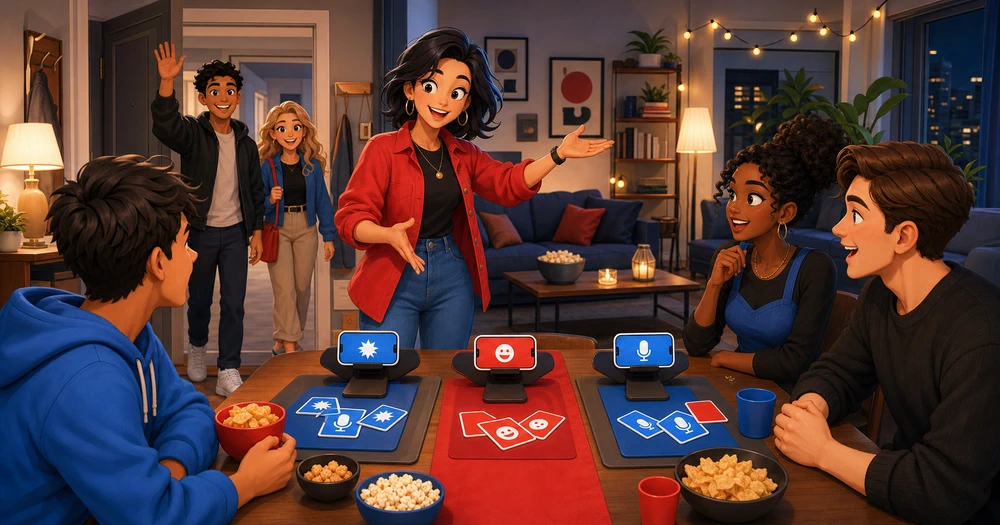
Game nights fail in two predictable places. The first is the opening twenty minutes, when nothing has started, people are standing near the food, and everyone is waiting for someone else to give the evening a shape. The second is around ninety minutes in, when the main game has genuinely run its course and nobody planned what comes after it.
Everything below is aimed at those two moments. It assumes four to ten people, one evening, and no equipment beyond the phones already in the room.
| When | What to do | Why it matters |
|---|---|---|
| A week out | Pick the date, message the group, name the first game | A named game converts "a thing at Sam's" into a plan people diarise |
| Three days out | Confirm numbers | Game choice depends on group size more than on group taste |
| The day before | Choose three games and a spare, prepare the prompts | The only preparation that actually changes the evening |
| One hour before | Set the room, put the food out | Nothing should need doing once people are there |
| Arrival | Start the opener with whoever is present | Late arrivals walk into a running room, not a silence |
| +20 min | Boundaries in one sentence, then the main game | Agreed before it is needed, never after |
| +60 min | Watch for the dip — change a rule, do not change games | A rule change is cheap; a new game costs the momentum |
| +90 min | First sign of fragmentation, move to the closer | A group that fragments for ten minutes does not reassemble |
| +2 to 3 hrs | Call it on a high | The ending is what determines whether there is a next one |
Give a start time, not a window
"From about seven" produces a first arrival at 7:40 and a first game at half past eight. Two specific times fix it: "7:30, games at 8." People anchor to the second number, which compresses the arrival window without anyone being told to hurry.
The games time also does something subtler — it tells everyone that there is a plan, which changes what they expect the evening to be. A group arriving at a scheduled thing behaves differently from a group arriving at an open-ended hang.
Say what the first game is in the invite. It costs one extra sentence and it converts an abstract social commitment into a concrete one, which is a much harder thing to drop out of on the day.
One more thing belongs in that message: an end time. It sounds unwelcoming and it does the opposite — people commit far more readily to a bounded evening than an open one, particularly anyone with a reason to leave early who would otherwise decline rather than explain. It also hands you the ending later on, which is the last step here and the hardest part of the night.
Do not ask the group what they want to play. A poll produces three suggestions, no decision and a thread that goes quiet. Decide, announce, and offer to change it if somebody objects — almost nobody does.
Confirm the number before you choose the games
Group size constrains game choice more than anything else, and it is the variable hosts most often leave until it is too late to act on. A game chosen for eight can be actively bad for fourteen.
| Group size | What works | What to avoid | Host difficulty |
|---|---|---|---|
| 3–5 | Deep games — Truth or Dare, the Hot Seat, Two Truths and a Lie | Anything needing teams or a crowd | Easy, but quiet players are exposed |
| 6–8 | Almost anything. The sweet spot | Nothing much | Easiest |
| 9–12 | Fast turns, or no turns — Most Likely To, Fishbowl, Mafia | Long individual turns | Moderate — pace is the job |
| 13–20 | No turn order at all, or split into two rooms | Truths; they do not carry | Hard — you are running a room, not playing |
The band that catches people out is nine to twelve. It feels like a normal group, but turn-based games have quietly stopped working — the gap between your turns is now long enough to check your phone in, and once one person does, the permission spreads.
Choose three games in a deliberate order
The order matters more than the selection. You want a fast opener that needs no explanation, a longer main game that rewards a warmed-up group, and a loud closer that gets people out of their seats.
- Opener, about 15 minutes. Would You Rather, Categories, or a personality quiz everyone takes at once. No turns, no rules, instant participation.
- Main game, 45 to 60 minutes. Truth or Dare, a friendship quiz, Lie Detector or a confession round. This is where the evening actually happens.
- Closer, about 15 minutes. Most Likely To, or a group-split game. High energy, everyone standing.
Hold a fourth in reserve. One of the three will not land with this specific group — not because it is a bad game but because chemistry is not predictable — and the difference between a dip and a stall is whether the replacement is already decided. The twenty-game list has the player counts and running times for picking one quickly.
Prepare the prompts the day before
This is the step everyone skips and it is the one that decides the night.
Improvised prompts converge on the same four questions within about ten minutes, and once a group has been asked what their most embarrassing moment is, the energy does not come back. Forty prompts per game is comfortable for an evening.
Two ways to hold them, and the difference matters more than it appears. On a screen everyone can see, or dealt by an app. What you want to avoid is one person reading prompts off their own phone, because that person is now hosting instead of playing, and every prompt arrives in their voice rather than neutrally.
If the main game is Truth or Dare, the prompts need matching to the group rather than just collecting — choosing prompts for your group covers the filtering, and it matters most when the group is not all close friends.

Set the room before you think about the food
Seating decides participation. A circle where everyone can see everyone else works; two sofas facing a television do not, because a group seated in rows will produce two conversations rather than one.
The practical test is whether the quietest person present can be seen by everyone without turning their head. If they are behind someone, they will not speak, and no amount of good prompt selection will fix a seating problem.
Lighting is worth thirty seconds of thought. Overhead lights make a room feel like a meeting; lamps make people talk more. This is a small effect but it is free.
Two more things that cost nothing and get skipped. Turn the television off rather than muting it — a screen with movement on it will pull eyes for the entire evening and people will not notice they are doing it. And put out more seating than you need, because a group that is one chair short spends the first twenty minutes negotiating rather than settling.
The awkward-corner test: stand where the least confident person in the group will end up sitting and look around. If you cannot see at least two-thirds of the other seats from there, move the furniture before anyone arrives.
Put out food that works one-handed
Food that needs cutlery stops the game. Food that needs a plate on a lap stops the game. Anything eaten standing up with one hand does not.
The bigger decision is timing: put everything out before people arrive rather than serving during. A meal partway through the evening resets the room to zero — everyone stands, side conversations start, and afterwards you have to rebuild the energy from the beginning rather than continuing.
If you do want a proper meal, put it at the front. Eat first, then play. The transition from eating into games works fine; the transition from games into eating and back does not.
Start the opener before everyone has arrived
Counter-intuitive, and it is the single highest-leverage thing on this list.
Starting something light with the first three or four people means late arrivals walk into a room that is already running. They join a game in progress, which requires nothing of them. The alternative — everyone sitting in a half-full room waiting for the last person — makes each arrival an event that interrupts whatever was tentatively starting.
Only the opener. Starting the main game early means re-explaining the rules for every arrival, which is worse than waiting. Pick something for this slot that someone can join mid-round without any explanation at all.
Set the boundaries in one sentence
Before the main game, not after something has landed badly. Name the pass rule and name what is off-limits. Fifteen seconds, said lightly, and then move on.
The reason to do it early is not caution, it is that doing it later is impossible. Once a prompt has made someone uncomfortable, any rule introduced afterwards is visibly about that moment and that person, which makes it worse than having said nothing.
A group that has agreed its own ceiling plays closer to it than a group that is quietly guessing where it is — the guessing is what makes people conservative.
The wording matters less than the timing, but a version that works is: "one free pass each, no reasons needed, and nothing about work or exes." Fifteen seconds, delivered as housekeeping rather than as a warning, and then start immediately so it does not become a discussion.
Mixed groups need this most and get it least, because the host usually knows everyone and forgets that the guests do not all know each other. If two people at the table have never met, the ceiling is genuinely unclear to them, and they will play three notches below it until somebody says where it is.
Recruit one person who is not you
The most common hosting failure is not a bad game choice. It is that the host spends the evening administering and never actually joins in, which everyone notices and nobody mentions.
It happens because the jobs are invisible individually — refilling something, letting someone in, finding a charger, explaining the rules again to the person who arrived late. Each takes ninety seconds. Together they mean the host has played about a third of the game everyone else played.
The fix is to tell one person in advance that they are the second host. Not to do anything specific, just to be the other person who notices when a glass is empty or when the game has stalled. Told beforehand, most people are pleased to be asked; discovered on the night, nobody volunteers.
The second job that should not be yours is reading prompts. If one person is reading every question aloud, they are running the game rather than playing it, and every prompt arrives coloured by their delivery. Either rotate the reader every round or use something that deals prompts to each phone independently.
Watch for the forty-minute dip
The opener is over, the main game is running, and the novelty has gone. This is the point at which a group either settles into the game properly or starts checking phones.
The instinct is to change games. That is usually wrong — it throws away the warm-up you have already paid for. Change a rule instead: introduce a sixty-second timer, add a round where everyone participates at once, shift the ratio toward whatever has been getting the better reaction.
A rule change costs nothing and re-engages the room because it is new information. A game change costs the setup time again and signals that the current game failed.
| What you are seeing | Likely cause | The cheap fix |
|---|---|---|
| Turns are taking too long | Too many players for this game | Add a sixty-second timer, no exceptions |
| The same two people are talking | No fixed turn order | Fix the order and go round the circle |
| Answers are getting shorter | Intensity climbed too fast | Take a turn yourself and pick something light |
| Phones are appearing | Too long between each turn | Switch to a round where everyone answers at once |
| Laughter has gone polite | The prompts have run out of range | Change the category, not the game |
The one signal on that list worth treating differently is the third. Shortening answers is the only one that is about comfort rather than pace, and the fix has to be immediate and unremarked — reading the room mid-game goes into what that looks like in practice.
Move to the closer the moment the room fragments
Around ninety minutes, the main game genuinely runs out. Side conversations start. Two people are talking about something else entirely and are not coming back.
This is not a failure and it does not need fixing — it is the signal to move. Do it immediately rather than trying one more round, because a group that has been fragmented for ten minutes does not reassemble, and the closer then has to compete with three conversations already in progress.
The closer should be loud, physical and short. Getting people out of their seats after ninety minutes of sitting does most of the work by itself.
Call it while people still want more
The most reliable predictor of whether a group does this again is whether the last game ended early. Somebody has to be willing to say "that is a good one to stop on" while the room is still loud, and that is harder than it sounds, because the room enjoying itself feels like an argument for carrying on.
It is not. The alternative ending — the game slowly dissolving as people drift into phones — is the version that attaches a feeling of mild disappointment to the whole idea, and that feeling is what surfaces next time someone suggests a game night.
The trick that removes the awkwardness: announce the finish time at the start. "We will play until about ten." Then the clock ends the evening rather than a person, and nobody has to be the one who called time on a room that was enjoying itself.
Frequently asked questions
How long should a game night last?
Two to three hours of actual games. Beyond that, groups fragment into side conversations regardless of how good the game is, and the last stretch is what people remember. Finishing while everyone still wants more is what makes the next one easy to arrange.
How many games should you plan for a game night?
Three, in a deliberate order — a fast opener, a longer main game and a loud closer — plus a fourth in reserve. The spare is not pessimism; group chemistry is genuinely unpredictable, and having a replacement ready turns a flat game into a dip rather than a stall.
What food works best for a game night?
Anything eaten with one hand and no cutlery, put out before people arrive rather than served during. A sit-down meal partway through resets the room to zero and you have to rebuild the energy from scratch afterwards.
How many people is ideal for a game night?
Six to eight is the easiest to host — big enough that quiet players are not exposed, small enough that turn-based games still move. Above ten you need games with no turn order, and above about fourteen you are effectively running two rooms.

Keep reading

Referring a Friend for a Job, and Everything Else That Happens When Work Gets Into a Friendship
A referral puts your reputation in a friend's hands. A promotion puts a friend's sense of where they stand in yours. Most awkward moments between friends and work trace back to that one change.
Truth or Dare Punishments: What Should Actually Happen When Someone Says No
A forfeit is a price, not a penalty. The difference decides whether a refusal keeps someone in the game or pushes them out of it — and almost every group gets it wrong by not deciding at all.

24 Birthday Party Games That Are Not Cake and Candles
The default birthday has not changed in eighty years: gather, sing, cake, candles, done. It is fine, and it is completely interchangeable — swap the name and it is somebody else's. What makes one feel specific is nearly always something the group made beforehand.