Truth or Dare Punishments: What Should Actually Happen When Someone Says No
Most groups have no forfeit rule at all, which is why one player quietly stops playing about forty minutes in. Here is the ladder that fixes it.
Ask most groups what happens when someone refuses a dare and you will get a shrug. There is no rule. Somebody says “nah, pass”, the room does a small collective recalculation, and the turn moves on with everyone slightly aware that something did not go smoothly.
That shrug is the reason games fall apart. Not because refusing is bad — refusing is essential — but because a refusal with no agreed price is a social event rather than a move. The player who passed now owes the room something undefined, the room does not know whether to press, and the next person to consider passing has watched all of it.
The fix is old. In the 1712 version of the game, a player who refused paid a forfeit or had their face smeared with soot. The soot can go. The published price list should not — knowing exactly what saying no costs is what makes people willing to keep playing.
A forfeit is a price, not a punishment
The distinction sounds like semantics and it changes the entire dynamic of the table.
A punishment is retribution for a wrong. It implies that refusing was a failure, that the player let the group down, and that the consequence is deserved. Played that way, a forfeit does the opposite of its job: it makes refusing expensive enough that people stop refusing, and a player who cannot refuse simply stops answering honestly instead. You have not bought yourself more disclosure. You have bought yourself worse answers delivered more confidently.
A price is neutral. It says: there are two legitimate ways to end your turn, here is the cost of each, choose. Nobody has failed. Nothing needs to be justified, and crucially, nobody has to explain why they are passing — which is the part that actually keeps people in the game, because the reason is usually the private thing they were avoiding in the first place.
If a player has to explain their refusal, you have not built a pass rule. You have built a second truth question.
The four-tier ladder
This is the whole system. It takes twenty seconds to agree and it covers every refusal that comes up in a normal evening.
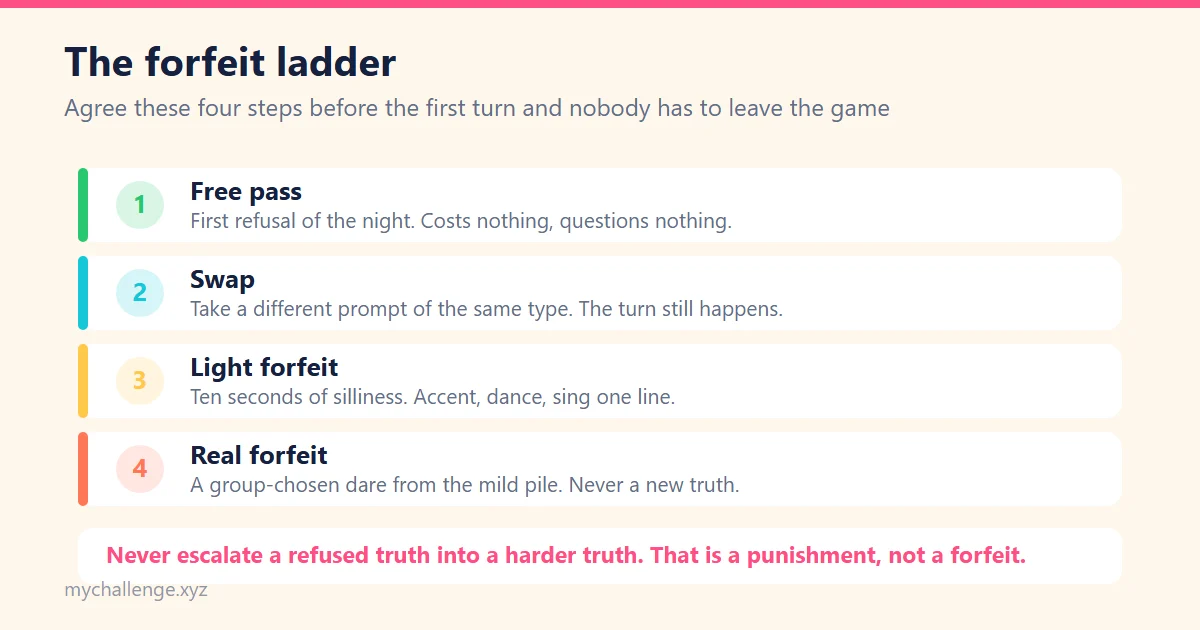
Tier 1 — the free pass
Every player gets one, per game, no questions. It costs nothing and it is not banked or traded. Its entire purpose is to exist: a player who knows they have a free pass in their pocket plays much closer to their limit than one who does not, because the exit is guaranteed.
Tier 2 — the swap
A different prompt of the same type. Refused a truth, take another truth. Refused a dare, take another dare. The turn still happens, the player still participates, and the group has lost nothing except one prompt.
This is the tier most groups skip, and it is the most useful one. The overwhelming majority of refusals are not “I do not want to play”, they are “not that one” — and a swap answers exactly that without any negotiation.
Tier 3 — the light forfeit
Ten seconds of performed silliness. An accent held for a round, a dance, one line sung, a daft hat. Short, visible, over before anyone gets uncomfortable, and involving no disclosure whatsoever.
Tier 4 — the real forfeit
A dare chosen by the group from the mild pile. Note the constraint: from the mild pile, and always a dare, never a truth. It is the last rung, it should be reached maybe twice in an evening, and if it is being reached constantly the prompts are wrong for this group rather than the players being difficult.
The rule that matters more than all four tiers: never escalate a refused truth into a harder truth. If somebody would not answer the question, a more invasive question is not a forfeit — it is a punishment for having a boundary, and it is the single most reliable way to end a game badly.
What a pass should actually cost
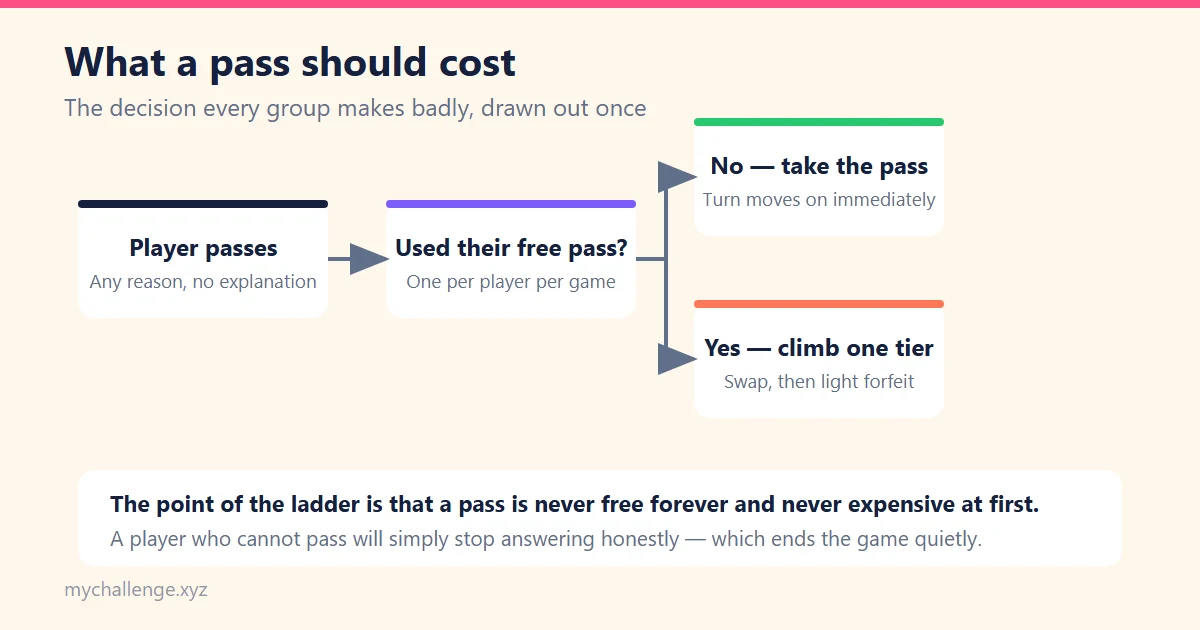
Two properties make this work, and they pull in opposite directions, which is why groups that improvise it usually get one and not the other.
The first: the price must never be zero forever. A player who can pass on everything at no cost is not playing, and their non-participation gradually gives everyone else permission to disengage too. This is the failure that “no rules, be nice” produces.
The second: the price must be small at the start. If the first refusal is expensive, players will not risk a turn they might want to refuse, so they choose the safest available option every time and the game flattens out. This is the failure that “no passing allowed” produces.
A free first pass followed by a gentle climb satisfies both. It is not a compromise between the two failures — it is the only shape that avoids them.
40 forfeits that work
Sorted by tier. Everything here is performed, brief, and involves no disclosure — which is the point, because the player arrived at the forfeit precisely by declining to disclose something.
Tier 3: light forfeits
- Hold an accent chosen by the group until your next turn.
- Sing one line of a song the person on your left picks.
- Speak only in questions for one round.
- Do a ten-second dance with no music.
- Let the group choose a new name for you until the game ends.
- Do your best impression of the last person who took a turn.
- Swap seats with someone and copy their posture for a round.
- Narrate the next player's turn like a sports commentator.
- Wear something silly, chosen from what is in the room, for two rounds.
- Laugh convincingly for ten seconds while nobody else may.
- Say the alphabet backwards until you make a mistake.
- Compliment everyone in the room, each one worse than the last.
- Give a fifteen-second lecture on a subject the group names.
- Replace every noun you say with “thing” for one round.
- Do a lap of the room in slow motion.
- Speak in a whisper until your next turn.
- Take on the personality of the person to your right for one round.
- Hum until someone guesses the song.
- Deliver the weather forecast for the room.
- Do a dramatic reading of the nearest bit of packaging.
Tier 4: real forfeits
- Take a dare chosen by the group from the mild pile.
- Answer the next round's prompt without the option to pass.
- Let the group pick your profile picture for one hour.
- Perform a thirty-second stand-up set about the room.
- Let the group choose your ringtone for the rest of the night.
- Do the dare from the previous round, whatever it was.
- Take two turns in a row on the next cycle.
- Let the person opposite ask the group one question about you.
- Perform a two-minute speech in praise of the person to your left.
- Let the group set you a rule you must follow for the rest of the game.
- Be the scorekeeper and the timekeeper for the next ten minutes.
- Give the group your phone's wallpaper choice for a day.
- Do a group-chosen accent for the remainder of the game.
- Teach the room a dance move and make everyone do it.
- Take the next dare without hearing it first.
- Let the group write your next message in the group chat.
- Sit out one round entirely and comment on everyone else's turn.
- Do the last three dares of the night in a row, all at tier one.
- Let the group choose which category your next prompt comes from.
- Nominate yourself for every group dare for the next fifteen minutes.
A test for any forfeit: could the quietest person in the room do it on their first turn without it becoming a thing? If not, it is a tier-four forfeit at best, and possibly not a forfeit at all.
Forfeits that never work
These turn up on every list and each one fails in a specific, predictable way.
- A harder truth. Already covered, and worth repeating because it is the most common mistake by a distance. It converts a boundary into a penalty.
- Anything involving drink. A forfeit that pressures someone to drink is not a forfeit, and in a mixed group it excludes anyone who is not drinking from having a legitimate refusal at all.
- Anything that outlasts the evening. Posting something publicly, sending a message that cannot be unsent, anything permanent. The forfeit should end when the game does.
- Anything requiring the room to judge quality. “Do it properly this time” is not enforceable and it turns the forfeit into an argument. If it needs adjudication, it is the wrong forfeit.
- Anything aimed at the same person twice. Two forfeits in a row landing on one player reads as a pile-on regardless of intent, and the person on the receiving end will feel it well before anyone else notices.
- Anything that removes someone from the game. “You are out” is the worst possible response to a refusal. The entire purpose of a forfeit is to keep the player in.
Group forfeits, and why they fix more than they should
Everything so far assumes the forfeit lands on one player. There is a second kind that most groups never think of, and it solves a problem the individual version cannot.
A group forfeit applies to everyone at once. Somebody refuses, and instead of that player performing, the whole room does the same silly thing for ten seconds. It sounds like a joke rule and it is unusually effective, for a reason worth spelling out: it removes the spotlight entirely from the person who just declined something.
That matters because the moment after a refusal is the most exposed moment in the game. The player has drawn attention to themselves by not doing the thing, and then the standard ladder immediately asks them to do a different thing while everyone watches. For a confident player that is fine. For the person the pass rule exists to protect, it is the same problem again with a smaller price tag.
Use group forfeits in two situations specifically. First, on any refusal from somebody who has been quiet — it lets them decline without a single second of individual attention. Second, whenever the game has drifted into targeting one person: three dares in a row landing on the same player changes the feel of a room quickly, and a round where everybody does the same thing pulls it straight again without anyone having to say what happened.
The cheapest version: every fifth refusal in the game becomes a group forfeit automatically. No judgement call required, and it arrives often enough to keep the atmosphere light.
Settling the three arguments that always come up
“They are passing on everything”
Usually true, usually not deliberate. A player who passes repeatedly has almost always concluded — correctly or not — that the prompts in play are aimed at something they do not want to discuss. Pressuring them produces compliance rather than participation.
The fix is a category change rather than a rule change. Move to prompts about opinions and preferences instead of history for a few rounds and watch whether they re-engage. If they do, the bank was wrong for them. If they do not, they are done for the night and that is allowed.
“That does not count as an answer”
The 1712 rules included this — a player had to satisfy the commander, not merely respond — and it is worth keeping, because technically answering while saying nothing is the most common way a game degrades without anybody breaking a rule.
But it needs an owner. Give the judgement to one person for the whole game rather than putting it to the room, because a group vote on whether somebody's answer was sincere enough is a considerably worse experience than the original question.
“Why do they get a free pass, they have not used a turn yet”
Free passes are per player, not per round, and they do not accumulate. Somebody who has taken four turns and somebody who has taken one both have exactly one. This is occasionally objected to and the objection is wrong: the pass exists to make the first risky turn takeable, so it has to be available at the start, when it is most needed.
Reading a refusal before it happens
A ladder handles refusals that get spoken. The harder problem is the refusal that does not — the player who is still technically participating but has stopped actually being in the game.

The tells are consistent across groups. Answers get shorter — three words where there were twenty a round ago. Laughter arrives a beat late and stops abruptly instead of trailing off. Someone who was leaning in is leaning back. And somebody starts pre-apologising: “this is boring, but…” before an answer nobody had questioned.
The correct response is deliberately unglamorous. Take the next turn yourself, choose something light, and let the intensity reset without commenting on it. Do not name the discomfort out loud — naming it makes it the centre of the room's attention, which is precisely what the person who flinched does not want.
The host's real job is not choosing good prompts. It is noticing, three seconds before anyone else does, that the last one did not land.
Age, and why the ladder changes shape
The ladder is the same for every group. What changes is where tier four sits.
| Group | Free passes | Tier 4 looks like | Watch for |
|---|---|---|---|
| Kids (7–12) | Unlimited | A silly performed dare | Anyone being singled out twice |
| Teens | 2 per player | A group-chosen mild dare | Phone dares and anything involving people outside the room |
| Adults, close friends | 1 per player | Group-chosen dare from the mild pile | One player passing on everything |
| Work or mixed | 2 per player | A light forfeit only — no tier 4 | Asymmetric risk between colleagues |
The work column deserves an extra sentence, because it is where this goes wrong most often. In a group of friends everyone risks roughly the same amount. In a work group people have very different amounts to lose, and the person with the most to lose is rarely the one setting the tone. There, unlimited passes and no tier four is not squeamishness — it is the only version that is fair.
For younger players the rule is simpler still: passes are free and unlimited, because the whole point at that age is that participating should never feel compulsory. Our kids deck and teens deck filter the prompts to match, which does most of the work before the ladder is needed.
Forfeits when you are not in the same room
Remote play changes one thing: a forfeit has to produce evidence, or the turn never closes. A player who says “done it” and moves on has ended the round without anything happening, and once that is established the game unravels quickly.
- Voice notes. The single best remote forfeit. Singing, an accent, an impression — all verifiable, all over in fifteen seconds.
- Profile changes. Display name, picture, status. Visible to everyone, reversible, and lasting exactly as long as you agree.
- Screenshots. Most-played song, step count, battery percentage. Trivial to produce and impossible to fake convincingly at speed.
- A skipped turn with a stated reason. Sometimes the right answer is simply forfeiting the round. Over text this is much less awkward than in person, and it should be allowed.
More on the mechanics of keeping a remote game moving in our guide to playing Truth or Dare over text.
When to drop the forfeit entirely
There is a point in a good game where the ladder stops being necessary. The group has warmed up, refusals have become rare, and enforcing a forfeit on the one person who does pass starts to feel like bureaucracy rather than structure.
Let it go when that happens. The ladder is scaffolding for the first half hour — its job is to make the early refusals cheap and predictable so that people take risks they otherwise would not. Once the group is past that, the scaffolding can come down.
What should not come down is the free pass. Keep that one available all evening, silently, without needing to be invoked by name. The knowledge that it exists is doing more work than it will ever be asked to do.
Read next
- Play Truth or Dare online — skips, rerolls and age filters handled by the game rather than by the room.
- The full rules and safety guide — how the pass rule fits with everything else.
- 104 funny dares for friends — the mild pile that tier four should draw from.
- Truth or Dare over text — where forfeits need proof to work at all.
- The history of Truth or Dare — the forfeit predates the dare by about two thousand years.
Frequently asked questions
What happens if you refuse a truth or dare?
In a well-run game, they take a forfeit — a small agreed consequence that lets the turn end without the player having to answer. In most real games nothing happens, because nobody set a rule, and the refusal becomes an awkward moment instead of a move. Agreeing the consequence in advance is what turns saying no from a social failure into a legitimate option.
What is a good punishment for Truth or Dare?
Something short, performed and visible: ten seconds in a silly accent, a dance, singing one line, wearing something daft for a round. Good forfeits are over quickly and involve no disclosure. The forfeit should never be a harder version of the thing the player just declined.
Should you allow passing in Truth or Dare?
Yes, and the version that holds up is one free pass per player per game, with a small escalating forfeit after that. A game with no passing does not produce more honesty; it produces one player who quietly stops engaging and answers everything with a joke.
What forfeits work over text?
Anything that produces evidence: a voice note, a changed profile picture, a screenshot. A forfeit the other person cannot verify does not close the turn, and an unclosed turn is how a text game stalls.
Are forfeits part of the original game?
They are the oldest part of it. A 1712 description of Questions and Commands has a player who refuses paying a forfeit or having their face smutted with soot. The dare as a freely chosen alternative is a much more recent invention.

Keep reading

The History of Truth or Dare: How a Medieval King's Game Ended Up on Your Phone
Truth or Dare has no inventor. It has ancestors — a Greek game recorded by a second-century grammarian, a medieval French courtship game, and an English parlour game that Joseph Addison recommended for a winter evening in 1711.

14 Games Like Truth or Dare, and When Each One Is the Better Call
Every alternative to Truth or Dare is a trade between how much people reveal and how many people it works with. Pick by group size first — it predicts success better than anything else.
Truth or Dare Over Text: How to Play So It Does Not Die After Four Messages
A text game does not die because you ran out of questions. It dies because nothing forces the next message. Add a deadline and a proof requirement and the same prompts run for days.