14 Games Like Truth or Dare, and When Each One Is the Better Call
Truth or Dare is not always the right tool. Sometimes the group is too big, too new, or too tired for turns — and something else does the job properly.

Truth or Dare has one structural weakness, and it is not the content. It is turn-based. One person is doing something and everyone else is watching, which is fine at six players and increasingly bad at fourteen — the wait between turns gets long enough that the room fragments into side conversations before it comes back round.
So the honest answer to “what else can we play” usually depends on a number rather than a mood. These fourteen are grouped by what they do differently, each with the group size it actually survives, and the specific situation where it beats the original.
A note on what is not here. There are no games requiring boxes, boards, printed cards or a trip to buy anything, because the situation that produces this question is almost always a room full of people who have already sat down. Everything below starts in under a minute with what is already in the room.
Would You Rather
Two options, everyone answers, and the argument afterwards is the game. It is the fastest thing on this list to start — no rules to explain, no turn order, no setup — and the only one that genuinely does not degrade at twenty players.
The reason it scales is that everybody answers every round. Nobody is waiting. That property is much rarer than it sounds, and it is why this is the correct opener for almost any group.
Its weakness is depth. Would You Rather will not tell you anything you did not know about someone, so it works as a warm-up rather than a main event.
The quality of the prompt matters more here than in any other game on this list, and the rule for writing them is counter-intuitive: both options must be genuinely defensible. A choice between something good and something terrible is not a question, it is a survey. The prompts that produce a twenty-minute argument are the ones where roughly half the room picks each side and both halves think the other is obviously wrong.
- Group size: 3–25
- Beats Truth or Dare when: the room is too big, or nobody has warmed up yet
- Play it: Would You Rather Challenge
Never Have I Ever
Structurally close to perfect: no turns, no equipment, instant participation, and information comes out sideways rather than through direct questions. You are not telling a story, you are putting a finger down, and that difference in exposure is why people disclose far more here than they would to the equivalent truth question.
It is the single best choice for a group that is half strangers, because it lets everyone participate at the level they choose without anyone noticing they chose.
The weakness is depth of bank. A group burns through the interesting prompts fast, and improvised ones converge on the same four topics within ten minutes.
It also has a failure mode nobody warns you about. Because a finger going down is public and the story behind it is not, the game generates enormous curiosity and then refuses to satisfy it. Half the value is in the follow-up conversation, so build in a rule for it — every third round, the person who put a finger down explains one of them. Without that, the game produces a lot of raised eyebrows and no actual information.
- Group size: 4–15
- Beats Truth or Dare when: the group is new, mixed, or not ready to be looked at directly
- Bring: at least 30 prepared prompts
Two Truths and a Lie
Everyone states three things about themselves; the group identifies the lie. It converts self-disclosure into a puzzle, which is a genuinely clever piece of design — the person talking is in control of exactly how much they reveal, and the group is engaged because there is something to solve.
The trick nobody explains: your lie should be boring. Everyone makes the lie the exciting one, which is precisely how it gets caught. A mundane lie sitting between two ridiculous truths is nearly unbeatable.
- Group size: 4–12
- Beats Truth or Dare when: people have just met and need a controlled amount of exposure
- Setup: one minute of thinking time, and enforce it
Most Likely To
A prompt goes up — most likely to miss a flight, most likely to start a podcast — and on a count of three everyone points at somebody. Fast, loud, and it scales further than almost anything else here because pointing takes no time.
One rule is worth adding and it is not optional: nobody may explain their vote. Explanations turn it into a debate, the pace dies, and the game becomes twenty minutes of four people justifying themselves.
- Group size: 6–25
- Beats Truth or Dare when: the room is loud and standing up
- Watch for: the same person getting pointed at repeatedly — rotate the prompt style if so
Paranoia
The most underrated game on this list. One player whispers a question to their neighbour — “who here is most likely to lie to get out of plans?” — the neighbour answers out loud with a name, and the room hears the answer but not the question. Whether the question gets revealed is decided by a coin flip or a rule you set.
It is unusually effective because the tension is doing all the work. Somebody has just said your name for an unknown reason, and you may never find out what it was. No prompt bank produces that feeling.
It needs an existing group. With strangers there is nothing at stake in hearing your name.
Set the reveal rule before you start rather than flipping for it each time, because the two versions play completely differently. Always-reveal is a lighter, funnier game with a good pace. Never-reveal is genuinely unsettling and should be used sparingly — a whole evening of it leaves a group with four unanswered questions each and a slightly odd atmosphere. A coin flip sits in between and is the version most groups should default to.
- Group size: 5–12
- Beats Truth or Dare when: the group knows each other well and standard questions have gone stale
- Note: agree in advance how often questions get revealed
The Lie Detector round
One person answers questions while everyone else votes on whether each answer is true. Points for fooling the room, points for catching a lie. It rewards the same skill as Two Truths and a Lie but gives you far more turns at bat, and the scoring keeps people engaged between their own turns.
It also solves a problem Truth or Dare has: the answers are more interesting when the person answering has a reason to perform. Here they do.
- Group size: 4–10
- Beats Truth or Dare when: the group is competitive and wants a score
- Play it: Lie Detector
Confession Wall
Everyone submits something anonymously; the group reads them out and tries to match confession to person. The anonymity is doing something a direct question cannot — people write things they would never say with their name attached, because at the moment of writing there is no audience.
This is the largest single lever in any of these games. It is not that the questions are better; it is that the answering conditions are different.
Needs an existing group. Strangers submit safe confessions, and safe confessions are not a game.
- Group size: 5–15
- Beats Truth or Dare when: the group is close but nobody will say the real thing out loud
- Play it: Confession Wall
Friend Mirror
You send a link out and find out what your friends actually think of you — collected separately, so nobody is performing for the group or softening it because you are in the room.
It is the asynchronous cousin of a truth round, and it produces a very different class of answer. A question asked in a circle gets an answer calibrated to the circle. The same question answered alone, on a phone, on a Tuesday, does not.
- Group size: any, answered individually
- Beats Truth or Dare when: people are not in the same place, or the honest answer needs privacy
- Play it: Friend Mirror
The Couple Challenge
Two people answer the same questions separately and the answers get compared. Nominally a couples game and it works just as well for best friends, siblings and colleagues, because the format is about how accurately two people predict each other rather than about romance.
The comparison is the entertainment, and it has a property most games here lack: there is a right answer, so the result is not a matter of opinion.
- Group size: 2 players, any size audience
- Beats Truth or Dare when: two people are the focus and everyone else is watching
- Play it: Couple Challenge
The Friendship Quiz
One person writes questions about themselves, everyone else answers, scores get compared. It is competitive in a way most social games are not, and the competition is what makes it stick — there is always one person who does much worse than they expected and has to account for it.
It lives or dies on question quality. Specific and slightly unfair beats broad every time: “what do I order every single time” is a far better question than “what is my favourite food”, because only somebody who has been paying attention knows it.
- Group size: 3–15
- Beats Truth or Dare when: the group wants a winner
- Play it: Friendship Calculator or the Friendship Dare Challenge
20 Questions
One person thinks of something; the group narrows it down with yes-or-no questions. It has nothing to do with disclosure at all, which is exactly why it belongs on this list — sometimes a group needs a break from being asked about itself.
Use it as a palate cleanser at the sixty-minute mark, when the personal questions have started to feel like work. Fifteen minutes of this and the room comes back to the main game with energy.
- Group size: 3–12
- Beats Truth or Dare when: the group is tired of being the subject
- Setup: none
Charades
Older than everything else here except the parlour games, and it survives for the same reason Truth or Dare does: it needs nothing, and it produces a performance the whole room can watch.
Its real advantage over Truth or Dare is that it is completely safe. There is no disclosure, no consent question, nothing that can go wrong socially — which makes it the correct choice for a work event, a family gathering, or any group with mixed levels of comfort.
- Group size: 4–20, in teams
- Beats Truth or Dare when: the group is mixed, professional, or includes people you cannot read
- Setup: two minutes of writing prompts
The horror dare round
Same skeleton as Truth or Dare with the atmosphere doing the escalation instead of the content. Late at night, lights down, prompts built around unease rather than embarrassment. It is a genuinely different experience from the standard game even though the mechanic is identical.
It works because fear and laughter sit next to each other. A group that has stopped reacting to ordinary dares will react to these.
- Group size: 3–10
- Beats Truth or Dare when: it is past midnight and the standard prompts have stopped landing
- Play it: the 3AM Horror Dare Challenge
Story Chain
One sentence each, round the circle, building a single story. No props, no prep, and it produces something the group can actually keep — which very few of these do.
Add one constraint or it drifts into nonsense within four turns: every sentence must contain the name of somebody in the room. That single rule turns it from an improv exercise into a game about the group.
- Group size: 4–12
- Beats Truth or Dare when: you want an ending you can screenshot
- Setup: none
Three that get recommended and should not be
Lists like this one tend to pad. In the interests of not doing that, here are three that appear on almost every roundup and are worse than their reputation.
Spin the Bottle
It is not really a game, it is a randomiser with one hard-coded outcome, and it puts a physical act on the table as the only possible result. That works for a very specific group in a very specific mood and is actively uncomfortable for everyone else. Truth or Dare does the same job with an escape hatch built in, which is why it outlasted its cousin.
Truth or Drink
The mechanic is fine and the incentive is backwards. A game where refusing to answer means drinking punishes the people least willing to disclose and rewards nobody, and it excludes anybody not drinking from having a legitimate refusal at all. If you want the format, use the forfeit ladder instead — it does the same thing without the coercion.
Would You Rather with shock prompts
The variant where every option is disgusting. It gets a big laugh for about four rounds and then the group has nothing to say, because there is no argument to be had — everyone agrees both options are horrible. The game runs on disagreement, and shock prompts remove it.
Diagnosing why the current game stopped working
Before switching, it is worth knowing which problem you are solving. A group that swaps games without diagnosing usually swaps into a game with the same failure.
| What it looks like | The actual problem | What to switch to |
|---|---|---|
| Long gaps, people on phones | Turn cycle is too slow for the group size | Would You Rather, Most Likely To |
| Answers getting shorter | Intensity climbed past where the room wanted it | 20 Questions, Charades — reset entirely |
| Same two people talking | No enforced turn order | Anything with simultaneous participation |
| Polite laughter, no follow-up | Group does not have the shared history the prompts assume | Two Truths and a Lie, Would You Rather |
| Everyone is engaged but it feels flat | No stake — nothing is being scored or decided | Lie Detector, Friendship Quiz |
| One person has stopped answering | No safe way to refuse | Fix the pass rule before switching games |
That last row is worth pausing on. It is the only one where changing game does not help — the same person will disengage from the next game for the same reason. It is a rules problem, not a content problem.
How to choose, in one step
There is a temptation to pick by mood. Mood is a much worse predictor than group size, which sets hard limits that no amount of enthusiasm overcomes.
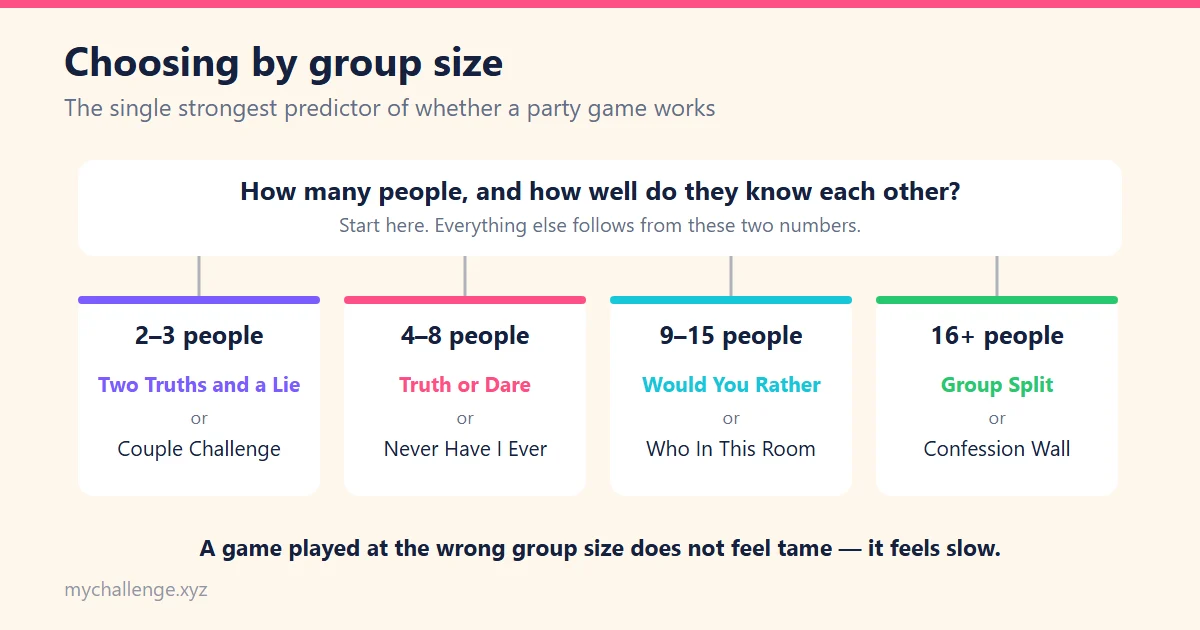
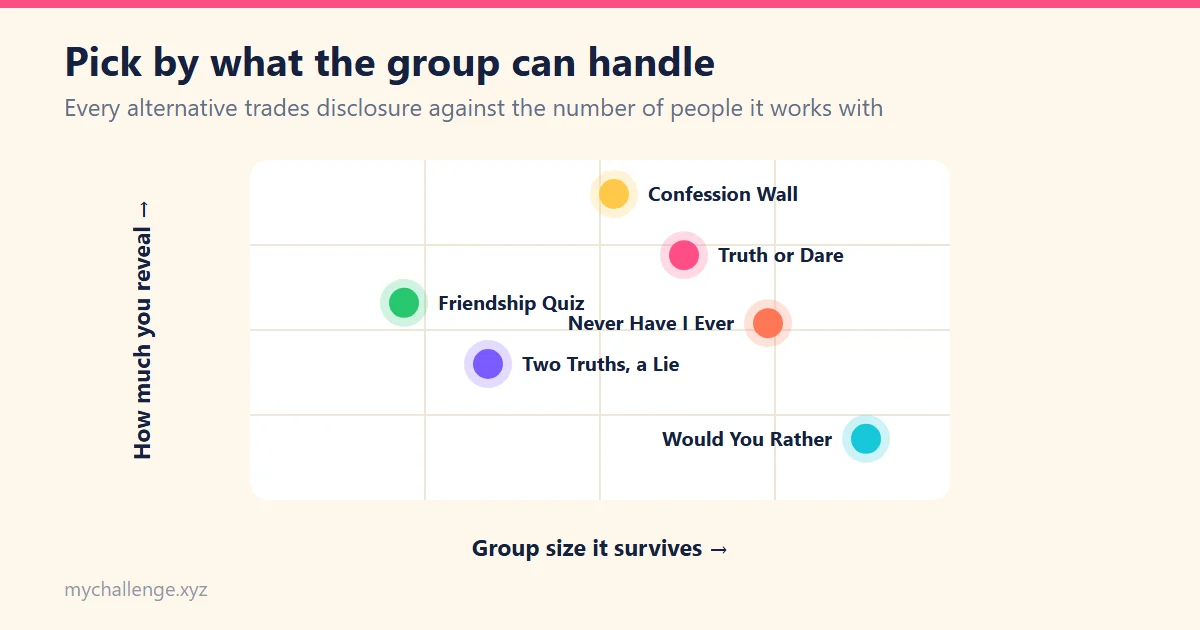
The second axis is how much the group is prepared to reveal, and that is mostly a function of how long they have known each other. Plotting the fourteen against both gives you a map of when each one is the right call.
| Situation | First choice | Second choice |
|---|---|---|
| Six close friends, evening | Truth or Dare | Paranoia |
| Twelve people, half strangers | Would You Rather | Never Have I Ever |
| Twenty-plus at a party | Most Likely To | Group-split Would You Rather |
| Work or mixed professional | Charades | Two Truths and a Lie |
| Two people | Couple Challenge | Two Truths and a Lie |
| Remote / different cities | Friend Mirror | Would You Rather |
| Kids and family | Charades | Age-rated Truth or Dare |
| Past midnight, group is flagging | 3AM horror round | Confession Wall |
The rule behind all of it
Every game on this page is a machine for making attention the default. In an unstructured conversation, paying attention is a choice each person renews continuously, and the moment it costs more than it returns, somebody reaches for a phone. A game inverts that: there is a turn order, a shared prompt, and a reason to look up.
Which particular machine you use matters less than whether it fits the room. A brilliant game played at the wrong group size does not feel tame. It feels slow — and slow is the only failure mode that a party game does not recover from.
So bring two. The first will not land with every group, and having a replacement ready is the difference between a dip and the end of the evening.
Keep reading
- Play Truth or Dare online — still the right answer for four to eight people who know each other.
- The friends deck — prompts built for a group that already has history.
- 104 funny dares for friends — for when you have committed to the original.
- Truth or Dare over text — several games here survive remote play better than Truth or Dare does.
- The history of Truth or Dare — most of these alternatives share the same ancestor.
Frequently asked questions
What is a good alternative to Truth or Dare for a large group?
Would You Rather and Most Likely To, because nobody waits for a turn — everyone participates on every round. Turn-based games like Truth or Dare get slow past about ten players, and the quiet half of the room disappears entirely.
Is Never Have I Ever better than Truth or Dare?
For a mixed or newer group, usually yes. Never Have I Ever reveals information sideways — you put a finger down rather than tell a story — so people disclose more with less exposure. Truth or Dare is better once a group is warmed up, because it produces actual answers rather than data points.
What games work with people who have just met?
Anything about preferences rather than personal history: Would You Rather, personality quizzes, Two Truths and a Lie. Confession-style games need existing trust and fall flat with strangers, because the confessions people are willing to make in front of strangers are all safe ones.
What can you play instead of Truth or Dare with kids?
Would You Rather, charades and Most Likely To all work well and have no disclosure component at all. If you want the Truth or Dare format specifically, use an age-rated version where the prompts are filtered rather than improvised.

Keep reading

The History of Truth or Dare: How a Medieval King's Game Ended Up on Your Phone
Truth or Dare has no inventor. It has ancestors — a Greek game recorded by a second-century grammarian, a medieval French courtship game, and an English parlour game that Joseph Addison recommended for a winter evening in 1711.
Truth or Dare Punishments: What Should Actually Happen When Someone Says No
A forfeit is a price, not a penalty. The difference decides whether a refusal keeps someone in the game or pushes them out of it — and almost every group gets it wrong by not deciding at all.
Truth or Dare Over Text: How to Play So It Does Not Die After Four Messages
A text game does not die because you ran out of questions. It dies because nothing forces the next message. Add a deadline and a proof requirement and the same prompts run for days.