
The History of Truth or Dare: How a Medieval King's Game Ended Up on Your Phone
Nobody invented Truth or Dare. It was assembled, over roughly two thousand years, out of games that were mostly about the forfeit.
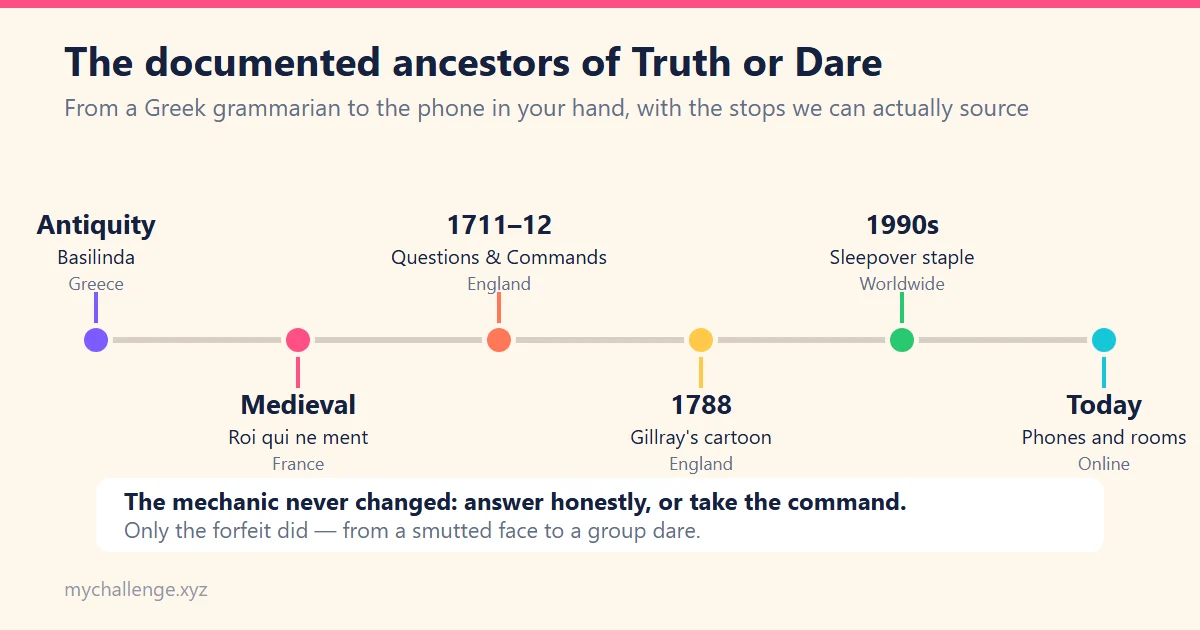
Ask who invented Truth or Dare and you will not get an answer, because there is not one. There is no inventor, no first game, no patent and no origin story that survives contact with a library. What there is instead is a chain of ancestors stretching back about two thousand years, each one recognisably the same idea wearing the clothes of its century.
The short version: the oldest recorded relative is a Greek game called basilinda, written down by a grammarian in the second century AD. The direct English forerunner is a parlour game called Questions and Commands, which Joseph Addison recommended in The Spectator in 1711 and which a 1712 source describes in full. The name we use now is a twentieth-century arrival. Everything else people confidently tell you about the game's origins is, on inspection, somebody's guess repeated often enough to sound like a fact.
The interesting part is not the dates. It is that the oldest and most stable component of the game turns out to be the one modern players treat as an afterthought.
The oldest version we can actually point to
Basilinda — βασιλίνδα — appears in the Onomasticon of Julius Pollux, a Greek grammarian writing in the second century AD. His description is short enough to quote in a sentence: a king, elected by lot, commanded his comrades what they should perform. The game has had enough scholarly attention to warrant a dedicated study of how it appears in Pollux.
That is the whole game. There is no board, no score and no way to win. A player is chosen at random, that player is given authority over everyone else for a turn, and the authority is exercised by issuing instructions. Pollux was not describing something new; he was cataloguing a game that was already ordinary enough to need recording.
Two features of basilinda survived every subsequent rewrite. The first is that authority rotates — the king is chosen by lot, not by status, which means the game briefly inverts whatever hierarchy exists in the room. The second is that the command is public. Both are still true of the game you played at a sleepover.
Everything invented since — the truth half, the categories, the age ratings, the wheel — is decoration on a two-thousand-year-old mechanic: somebody gets to tell you what to do, and everyone watches.
The king who does not lie
Medieval France contributes the half of the game that basilinda did not have. Le roi qui ne ment — the king who does not lie — is documented in medieval French sources and has attracted enough scholarly attention to have its own literature, generally in the context of aristocratic courtship rather than children's play.
The premise is a neat inversion of the Greek game. Whoever holds the crown is not the one issuing commands; they are the one who must answer. Every question put to the king has to be answered honestly. There is no deflecting and no changing the subject.
You can see immediately why this was a courtship game. In a social setting where direct questions were largely forbidden, a game that suspends the rule for one person at a time is not a diversion — it is a device. It let people ask things they could not otherwise ask, and it gave the person answering a defence: they were not confessing, they were playing.
That defence is the entire social function of the game, and it is why it has never gone out of use. A truth question is not really a request for information. It is permission to say something you were already carrying around.
Questions and Commands, and the year it got written down
By the eighteenth century the two halves had merged in England into a single game called Questions and Commands, and it was thoroughly mainstream. In 1711 Joseph Addison included it in an issue of The Spectator among the innocent amusements suitable for a winter night — a reference Bryn Mawr's Special Collections traces along with the game's later appearances. That Addison could list it without explanation tells you how ordinary it was.
The rules themselves are usually quoted from a 1712 attestation: Questions and Commands is a Christmas game in which the commander bids their subjects to answer a question which is asked, and if the subject refuses or fails to satisfy the commander, they must pay a forfeit or have their face smutted.
Read that again, because it contains the whole design. There is a commander. There is a question. There is a refusal clause. And there are two escalating consequences — a forfeit, or having your face smeared with soot from the fireplace.
A note on that 1712 date, since every page on this subject repeats it and almost none of them say where it comes from. The wording above is not quoted from a surviving 1712 document — it reaches us through E. Cobham Brewer's Dictionary of Phrase and Fable of 1898, a Victorian reference work asserting the earlier attestation. That is good evidence and it is not a primary source, which is a distinction worth keeping when you see "1712" stated flatly elsewhere.
The game turns up in fiction too. In Oliver Goldsmith's The Vicar of Wakefield in 1766, the family plays questions and commands at a Michaelmas Eve party — the sort of detail a novelist includes precisely because it needs no explanation to a contemporary reader.
The forfeit is the oldest part of the game
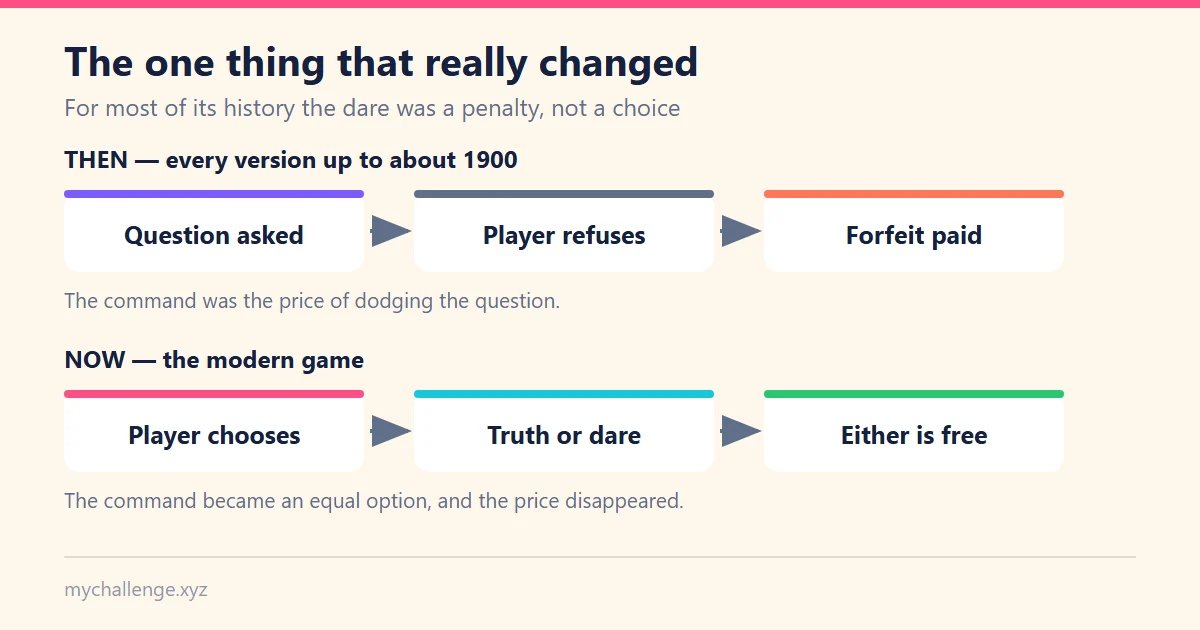
Here is the thing that surprises people. In the 1712 version, the dare does not exist as an alternative you choose. It exists as a punishment for refusing. You are asked a question, and if you will not answer it — or if your answer does not satisfy the room — you pay.
Modern Truth or Dare inverts this completely. Dare is now the fun option, the one people pick when they cannot face a truth, and the forfeit has shrivelled to an embarrassed shrug when somebody passes. Most groups do not have a forfeit rule at all, which is why a modern game so often ends with one player quietly opting out of everything.
The historical version was harsher and structurally better. It made refusal a legitimate move with a known price, rather than a social failure with an unknown one. Everyone at that eighteenth-century table knew exactly what saying no would cost, and could decide accordingly.
Worth stealing: the old game's real innovation was a published price list. If your group agrees what a pass costs before the first turn, you have reinvented the best part of the 1712 rules. There is a whole method for this in our guide to Truth or Dare punishments and forfeits.
Face-smutting deserves a moment of its own. It was chosen because it was visible and lasting: a smutted player carried the evidence of their refusal for the rest of the night, in front of everyone. That is a considerably more serious sanction than anything in a modern game, and it was applied at Christmas, to family.
How the two halves fused
The Greek game is all command and no question. The French game is all question and no command. The English one has both, and the join is the most interesting thing in the game's history because it is where the modern experience actually comes from.
The mechanism is the refusal clause. Once a game contains a question that must be answered, it needs an answer to the obvious follow-up — what happens if somebody simply will not. A game with no consequence for refusing is not a game; it is a conversation with extra steps. So the command came back, not as an alternative to the question but as the price of dodging it.
This is why the two halves fit together so naturally, and why nobody records the moment they merged. They did not merge. The command was always the enforcement mechanism for the question, and the two were never really separate ideas.
What did change, much later, was the direction of choice. In every historical version the question comes first and the command is the consequence. In the modern game the player chooses between them up front, as equals. That single inversion is responsible for most of what a modern group experiences — including the very common player who says “dare” every single time, which is not a personality trait so much as an available strategy that did not exist before the twentieth century.
The forfeit economy
Questions and Commands did not exist in isolation. It sat inside a whole genre of eighteenth and nineteenth-century parlour entertainments that ran on forfeits, and understanding that genre explains a lot about why the game is shaped the way it is.
In a typical evening, several different games would be played, and each one generated forfeits — small penalties owed by players who lost, hesitated, laughed at the wrong moment or broke a rule. These were not discharged immediately. They accumulated. Players surrendered a personal item as a marker of each forfeit owed, and at the end of the evening there would be a redemption round in which the items were held up one at a time and a consequence assigned to each.
Two things follow from this. First, the consequence was decided by the room, not by the person who caused it — the sentence was pronounced by whoever was presiding, often without knowing whose item they were sentencing. Second, forfeits were a currency rather than a punishment. Owing one was normal. Everybody owed several by the end of the night.
That is a strikingly different atmosphere from a modern game, where a single pass can feel like a small social failure. The historical version had no such weight attached, precisely because refusal was routine, priced, and universal.
The design lesson: a consequence that everybody incurs is not a punishment. It is part of the game. The moment forfeits became rare, they started to feel like judgements — which is the problem most modern groups are actually experiencing when they say a game “got awkward”.
What an eighteenth-century cartoon tells us
There is a persistent belief that Truth or Dare was once wholesome and has been coarsened by modern teenagers. The archive does not support it.
In 1788 James Gillray, the most savage caricaturist of his generation, published a print titled Questions and commands; or, the mistaken road to He-r-f-rd; a Sunday evening's amusement. It depicts a room mid-game, and the forfeit being performed involves a gentleman putting his head under a lady's dress. The reactions of the other players — delight, outrage, and several people pretending not to look — are the actual subject of the picture.
Gillray was satirising the respectable classes, which only works as satire if the audience recognised the scene. In other words: in 1788, an English viewer looking at a print of a parlour game did not need to be told that these games got out of hand. It was the joke.
The game arrived in the twentieth century already carrying a reputation. Every generation since has assumed it acquired that reputation on their watch.
How it became a game for teenagers
Parlour games declined for an unremarkable reason: the evening filled up with other things. Recorded music, radio, cinema and eventually television removed the problem that parlour games existed to solve, which was a room full of people and nothing scheduled to happen in it.
Most of the forfeit games disappeared entirely. Truth or Dare did not, and the reason is that it migrated rather than died. It moved out of the drawing room and into the bedroom, the sleepover, the school trip and the party — the remaining social situations where a group of people are stuck together with no external entertainment and a strong interest in finding out about each other.
That migration changed its character. Played by adults at Christmas, it was a comedy of manners. Played by fourteen-year-olds at midnight, it became something closer to an instrument: a socially sanctioned way to ask the questions the group had been circling for weeks. Its association with adolescence, romance and slight danger dates from this period, not from anything in the older game.
It is also when the name settled. Questions and Commands describes the mechanic; Truth or Dare describes the choice. The rename marks the moment the dare stopped being a punishment and became an option — arguably the single largest change in the game's two-thousand-year history.
Every generation thinks it invented the risky version
There is a remarkably consistent pattern in how people talk about this game across three centuries, and once you notice it you cannot stop noticing it.
Gillray's audience in 1788 found the idea of a parlour game producing scandal funny enough to buy a print of it. Victorian etiquette writers fretted about which forfeit games were suitable for mixed company. Mid-century parents worried about what happened at sleepovers. Contemporary commentary worries about phones and what gets recorded. In each case the speaker believes the game has recently become more dangerous than it used to be, and in each case there is a print, a pamphlet or an article from a century earlier saying the same thing.
The reason is structural rather than moral. The game has always been a device for approaching the edge of what a group will tolerate, and the edge is defined by the group, not by the game. A version played by fourteen-year-olds and a version played at a Georgian Christmas are both operating at the limit of their respective rooms. They only look different from outside.
Which is worth remembering when a game does go wrong. It is almost never because the prompts were too strong in the abstract. It is because they were too strong for that particular room, and nobody had established where its edge was.
1991: the name in lights
In 1991 Madonna released a documentary about her Blond Ambition tour and called it Madonna: Truth or Dare. It was, at the time, among the highest-grossing documentaries ever made, and it put the phrase in front of an enormous audience that had no particular interest in party games.
The film matters to the game's history for one narrow reason: it fixed the name. Before it, regional variants and older labels were still in circulation. Afterwards, the phrase was doing double duty as the title of the game and as a shorthand for candour with an edge — which is roughly what the game had always been, now with a marketing department.
The 2018 horror film of the same name, in which the game turns supernatural and lethal, sits at the other end of the reputational scale. It is not a good film. It is, however, a useful data point: by 2018 the game was recognisable enough to carry a mainstream horror premise with no explanation required. Very few games are that legible.
What actually survived
Strip away the centuries and the surviving core is remarkably small. Four things have been present in every version from Pollux onward.
- Random selection. The king is chosen by lot. Nobody volunteers for the spotlight, which is what makes the spotlight bearable.
- Compelled disclosure or compelled action. You answer, or you do. Both are performed in front of the group.
- A refusal clause. Every version has one. The price has changed enormously; the existence of a price has not.
- An audience. Nothing in the game works played privately. The room is a participant.
Everything else is period detail. The soot, the crown, the Christmas setting, the categories, the phone: all of it is interchangeable. You could hand the 1712 rules to a group tonight and they would be playing within a minute, which is not something you can say about many three-hundred-year-old games.
It is worth asking why this particular design proved so durable when the rest of the forfeit games did not. The likeliest answer is that it solves a problem that has not gone away. Groups of people who like each other routinely fail to ask each other anything interesting, and a game that makes the asking somebody else's fault removes the risk. That was true in a Greek courtyard and it is true in a group chat.
Playing the older versions tonight
Three of these are genuinely worth trying, and each fixes a specific failure in the modern game.
The 1712 rules
One commander per round rather than a free-for-all. The commander asks; the player answers or pays. Crucially, the room judges whether an answer counts — “fails to satisfy the commander” is doing real work in that description, and it kills the strategy of technically answering while saying nothing.
The king who does not lie
One player takes the crown for a fixed period — five minutes is plenty — and during that time anyone may ask them anything. No dares at all. It is a far more intense format than it sounds, and it is much better than standard Truth or Dare for a group that already knows each other well, because it removes the escape hatch that regular players lean on.
Forfeits with an actual price
Bring back the published consequence, minus the soot. Agree the ladder before you start, apply it consistently, and watch how much more willingly people take a turn when the downside is known. Our rules and safety guide sets out a modern equivalent.
If you only take one idea from three centuries of this game: the version where refusing is free is not the kind version. It is the version where the quietest person in the room slowly stops playing and nobody notices.
Where to go next
If you came here for the history, that is the history. If you came here because you are about to play, the practical material is elsewhere on the site and rather more useful than a Greek grammarian.
- Play Truth or Dare online — solo, pass-the-phone, or a live room everyone joins from their own device.
- The Truth or Dare question bank — thousands of prompts, filtered by age rating and intensity.
- 104 funny dares for friends — the dare half, sorted into tiers so a group escalates together.
- Truth or Dare over text — how the game survives when nobody is in the same room.
- 14 games like Truth or Dare — and when each one is the better call.
Sources
Every dated claim above resolves to one of these. Where competitor accounts assert precise dates we could not stand behind — a specific 1345, a 1677 attestation — the claim has been left out rather than repeated.
- Julius Pollux, Onomasticon (2nd century AD) — the description of basilinda. Scanned edition at the Internet Archive.
- Salvatore Costanza, “Le jeu de la Basilinda et autres pratiques ludiques… dans l’Onomasticon de Pollux” — scholarly treatment of the Pollux passage.
- Bryn Mawr College Special Collections, “A New Game of Questions and Commands” — Addison's 1711 Spectator mention, the Goldsmith reference, and the Gillray print.
- Wikipedia, “Truth or dare?” — for the 1712 attestation and the “face smutted” wording, which it sources to E. Cobham Brewer's Dictionary of Phrase and Fable (1898) rather than to a primary document.
- Oliver Goldsmith, The Vicar of Wakefield (1766) — the Michaelmas Eve scene.
- James Gillray, Questions and commands; or, the mistaken road to He-r-f-rd (1788).
Frequently asked questions
Who invented Truth or Dare?
Nobody. There is no inventor and no first game. Truth or Dare is a folk game — it was assembled over centuries out of older command games, and the version we play now only settled into its current name during the twentieth century. The oldest recorded ancestor is the ancient Greek game basilinda, described by the grammarian Julius Pollux, in which a king chosen by lot commanded the other players.
How old is Truth or Dare?
The mechanic is roughly two thousand years old. The recognisable English version, Questions and Commands, is a little over three hundred: Joseph Addison mentions it in The Spectator in 1711, and a 1712 source gives its full rules. The name “Truth or Dare” itself is far younger and became standard only in the twentieth century.
What was Truth or Dare originally called?
In English, Questions and Commands. The commander asked a question; a player who refused it, or gave an answer the room rejected, paid a forfeit instead. Earlier relatives include the French courtly game le roi qui ne ment — the king who does not lie — and the Greek basilinda.
What happened if you refused in the original game?
According to the 1712 description, a player who refused or failed to satisfy the commander “must pay a forfeit or have their face smutted” — smeared with soot from the fireplace. It was public, visible for the rest of the evening, and impossible to talk your way out of. Our modern forfeits are far gentler than the original.
Is Truth or Dare related to Spin the Bottle?
They are cousins rather than parent and child. Both descend from the same family of parlour and forfeit games that dominated European evenings before recorded music and television. Spin the Bottle solved the problem of choosing a player at random; Questions and Commands solved the problem of what to do with them once chosen.
