Truth or Dare Over Text: How to Play So It Does Not Die After Four Messages
Remote Truth or Dare fails for one structural reason, and it is not the questions. Here is the loop that fixes it, plus 54 prompts built for a screen.
Truth or Dare over text dies at about the fourth message. Somebody sends a good question, somebody answers it, and then there is a gap — and the gap gets longer, and forty minutes later the game has quietly become a normal conversation about something else.
That is not a content problem. You did not run out of questions. It is a structural one: in a room, the next turn happens because the person beside you is looking at you. Over text, nothing whatsoever obliges anyone to move, so the game has to supply the obligation itself.
Two rules do it. Every turn gets a deadline, and every dare needs proof. Add those and the same prompts you already have will run for days. The rest of this guide is that loop in detail, 54 prompts written specifically for a screen rather than a living room, and what changes when you move to a video call.
Why text games stall
It is worth being precise about the failure, because the usual advice — “use better questions” — treats a symptom.
An in-person game has three free mechanisms that text does not. There is a turn order everyone can see, because people are sitting in an order. There is social pressure, because a pause is visible and uncomfortable. And there is an immediate audience, so a dare has somewhere to land.
Text has none of these. The turn order exists only in someone's head. A pause is invisible — a person who has not replied for twenty minutes looks identical to a person who is composing something. And a dare performed alone in a room, with nobody watching, is not a dare at all; it is a suggestion.
Every rule below exists to replace something that a room gives you for free.
The four-step loop
This is the whole method. It takes ten seconds to agree and it is the difference between a game that lasts an evening and one that lasts four messages.
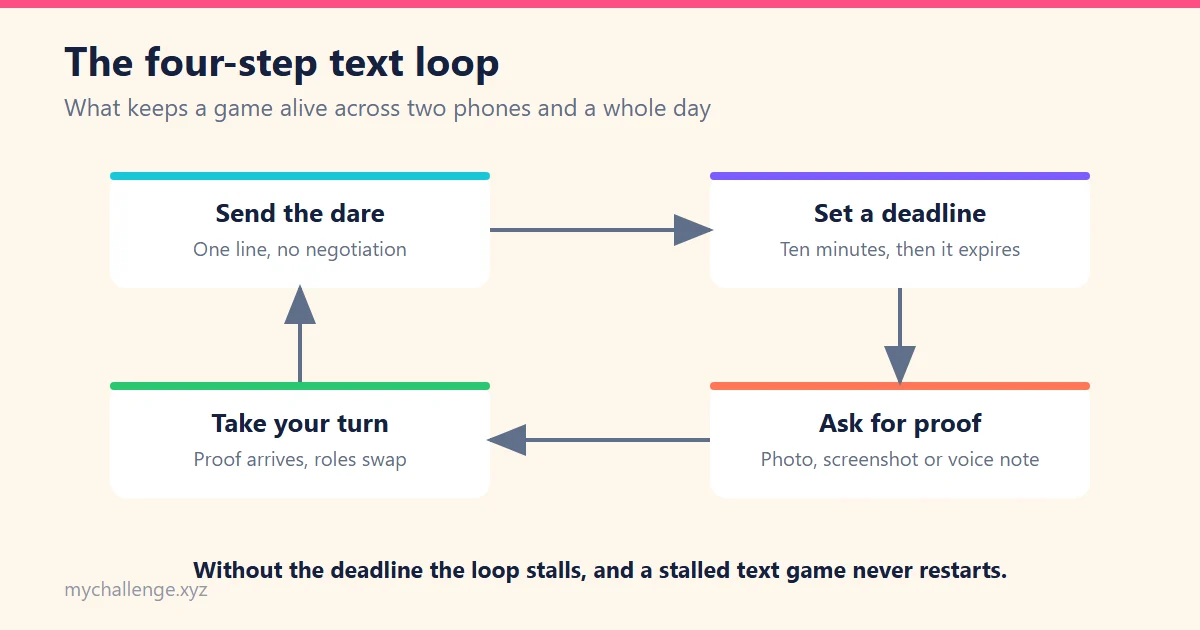
1. Send the prompt as a statement, not a negotiation
“Truth or dare?” followed by “ok so maybe something like…” is where half of these games end. Decide the prompt before you send anything, then send it in one message. A prompt that arrives with visible hesitation gives the other person permission to hesitate back.
2. Put a clock on it
Ten minutes for a live session, one day per turn if you are playing across time zones. Say the number out loud at the start of the game. The deadline is not there to be enforced — nobody actually wants to police it — it is there so that not replying becomes a choice rather than a drift.
3. Require proof for dares
A photo, a screenshot, a voice note, a changed profile picture. If a dare cannot produce evidence, it does not belong in a text game. This one rule eliminates about eighty per cent of standard dare lists, which is why the dare section below is shorter than the truth section.
4. Swap immediately
The moment proof arrives, the roles reverse and the next prompt goes out. The most common way a working text game dies is a long friendly exchange about the answer, after which nobody sends the next turn. React briefly, then send.
The one-line version to paste into the chat: “Ten minutes per turn, dares need proof, and whoever answers sends the next one.” That is the entire ruleset.
30 truths built for a screen
Truths are the strength of text play, and it is worth understanding why: people write more honestly than they speak. There is no eye contact to manage, no audience reaction arriving in real time, and a few seconds of thinking time that a live round does not give you. Questions that would get a deflection in a room quite often get a real answer over text.
These are written for that. They reward a paragraph rather than a word.
- What is something you have changed your mind about this year?
- What is the last thing you typed out and deleted before sending?
- Which of your friendships takes the most effort, and is it worth it?
- What do you think people assume about you that is wrong?
- What is the nicest thing anyone has said to you that you did not believe?
- What is a decision from the last twelve months you are still not sure about?
- Who is someone you think about more than they would guess?
- What is the pettiest thing you have held a grudge about?
- What compliment do you get most often, and does it land?
- What is something you own that you would be embarrassed to explain?
- What did you think of me the first week we met?
- What is the most useless thing you know a lot about?
- What is a rule you follow that nobody asked you to follow?
- What is something you have never told anyone in your family?
- When did you last feel genuinely proud of yourself, and why?
- What is a habit of yours that would annoy you in someone else?
- What is the last thing that made you cry, honestly?
- What do you spend money on that you cannot justify?
- What is a compliment you have given that you did not mean?
- What is the biggest lie you have told to get out of something small?
- Which version of yourself, from any year, would you least want to meet?
- What is something you pretend to enjoy?
- What do you do when nobody knows what you are doing?
- What is the last thing you searched for that you would not want read out?
- What is a thing you are quietly competitive about?
- Who do you compare yourself to most, and why that person?
- What is something you would change about how we met?
- What is a conversation you keep meaning to have and keep not having?
- What is the kindest thing you have done that nobody found out about?
- What do you want that you have never said out loud?
Note how few of these are about the past. Text play tends to produce better answers to present-tense questions, because the person answering is composing rather than recalling, and composition is where the honest version turns up.
24 dares that produce evidence
Every one of these ends with something the other person can see. That is the only criterion that matters over text.
- Send a voice note singing the chorus of the last song you played.
- Change your profile picture to one the other person chooses. One hour minimum.
- Screenshot your most-played song of the month and send it with no explanation.
- Send a photo of the inside of your fridge.
- Record a ten-second video reading your last sent message as a news anchor.
- Send the fourth photo in your camera roll and explain it.
- Text one friend a sincere compliment and screenshot their reply.
- Change your display name to whatever the other person picks, for a day.
- Send a voice note doing your best impression of me.
- Screenshot your screen time for yesterday.
- Send a photo of the view from wherever you are standing right now.
- Record yourself explaining your job to a five-year-old. Sixty seconds.
- Send your last three search terms, unedited.
- Post something the other person writes to a story, and leave it up for an hour.
- Send a photo of the messiest thing within three metres of you.
- Voice note the last argument you had, playing both sides.
- Screenshot your notification list and send it as it is.
- Send a picture of what you are wearing, whatever it is.
- Record a thirty-second review of the last thing you ate.
- Send the oldest photo on your phone.
- Text the third person in your recent chats a single word and screenshot it.
- Change one contact's name to whatever the other person chooses and prove it.
- Voice note the alphabet backwards. Every mistake earns another dare.
- Send a photo of your current battery percentage and accept the consequence.
Where this goes wrong: dares that involve a third party — messaging an ex, a boss, a stranger — are the ones people regret. The other player will never see the fallout, which is exactly why the dare feels harmless to send and does not feel harmless to receive. If the person on the other end of the message has not agreed to be in this game, do not put them in it.
Opening a text game without it being weird
There is an awkwardness particular to starting one of these, and it is worth addressing because it stops a lot of games before they exist. Sending “truth or dare?” cold, to one person, reads as a proposition in a way that suggesting it to a room does not. The format has no ambient context — there is no party, no circle, nothing to make it obviously a game.
Three openings that work, in rough order of how little they commit you:
- Name the format. “Bored — truth or dare, ten minutes a turn, dares need proof?” Stating the rules makes it a game rather than an approach, and the specificity does most of the reassuring.
- Lead with your own turn. Answer a question you have set yourself, then hand over. It costs you the first disclosure and removes any suggestion that the other person is being put on the spot.
- Start from something already happening. If a conversation has already produced a question somebody dodged, that is the game beginning on its own. “Fine — truth or dare then” is a much easier opening than a cold one.
What does not work is the drawn-out negotiation: are you up for a game, what kind of game, do you want to play truth or dare, are you sure. By the time the game starts, everyone involved has had four opportunities to feel self-conscious about it.
Tone is the thing text removes
Text strips out everything except the words. No face, no timing, no volume — and a prompt that would be obviously playful spoken aloud can arrive flat, or pointed, or slightly aggressive, depending entirely on what the reader happened to bring to it.
This cuts both ways and the good side is genuinely good: without a face to react to, people answer more fully. The bad side is that a misread lands silently. In a room, a question that goes wrong produces a visible flinch and the group adjusts. Over text, the person just takes a bit longer to reply, and there is no way to tell that apart from being busy.
Three habits cover most of it.
- Over-signal the tone. The thing that feels like too much punctuation or too many emoji in a normal message is roughly the right amount inside a game, because the prompt has no other tonal information attached to it.
- Give an explicit out with each prompt. “Skip if you would rather” costs six words and removes the need for the other person to work out how to decline. They will use it far less often than you expect, which is the point.
- Treat a long gap as data, not silence. If a reply is slow after a heavier question, send something light rather than waiting it out. Waiting reads as pressure even when it is patience.
One asymmetry worth knowing: the person sending a prompt experiences it as a moment; the person receiving it experiences it as a message sitting on their phone until they deal with it. That is why a question that felt casual to send can feel weighty to answer, and why the deadline should be short enough that nothing sits around.
Long distance and different time zones
A ten-minute deadline is useless when one person is asleep. The instinct is to schedule a session and play live, which works occasionally and mostly produces two people waiting for a window that keeps moving.
The better format abandons the session entirely. One turn each per day, no clock beyond that. It sounds slower and it is considerably more durable — the game becomes an ongoing thing between two people rather than an event that has to be organised, and it survives a bad week without dying.
Three adjustments make the daily version work:
- Shift heavily toward truths. A dare with a twelve-hour turnaround loses its energy. Truths do not — a good question sitting in someone's head for a few hours often gets a better answer.
- Keep a running thread. Pin the game to one chat or keep a note of the score. Without a visible record, the game does not exist between turns and quietly stops.
- Allow banked turns. If someone misses a day, they owe two. This is much better than a strict deadline, which just makes a missed day feel like a failure and ends the game.
Played this way it holds up for months, which is not something the live version manages.
What changes on a video call
A call restores the two things text is missing — an audience and visible pauses — and it introduces a new problem that most people never name.
The reader problem
Somebody has to have the prompt list. That person is now reading questions off a screen, deciding which one to use, and delivering it in their own voice. They are running the game rather than playing it, and it changes the prompt itself: a question read out by a friend who chose it lands very differently from a question that simply appeared.
It also means one person is never surprised. The best moments in Truth or Dare come from the room reacting together, and the reader has already read it.

The fixes
If you are staying on a call, rotate the reader every round so at least the burden is shared, and use a prompt source nobody controls so the reader is not also choosing. If you want the problem to actually go away, everyone needs to see the same prompt on their own screen at the same time — which is what a shared live room is for. Nobody reads, nobody chooses, and the awkward pause after a hard truth belongs to the group instead of to whoever spoke it aloud.
Group chats: the version that usually fails
Playing in a group chat sounds like the natural extension and it is the weakest format on this page. The reasons are mechanical rather than social.
- Turn order collapses. Three people answer at once, two people ask questions simultaneously, and within five minutes nobody knows whose turn it is.
- The prompt scrolls away. By the time the slowest person opens the chat, the question is forty messages up.
- Nobody is accountable. In a chat of eight, not answering is invisible. The people who most need a prompt to make them speak are exactly the ones who disappear.
If you are committed to the group chat, the only version that holds is rigid: name the next player explicitly in every message, one prompt live at a time, and no new prompt until the current one is answered. It is laborious, and it works.
For anything above five people, a room where the turn order is handled for you is a categorically different experience. That is not a marketing line — it is the same reason a board game has a board.
The rule about screenshots
This is the one genuine ethical difference between text play and in-person play, and it gets almost no attention.
A truth answered in a living room evaporates. A truth answered over text is a durable, forwardable object that exists on somebody else's device indefinitely. The person answering usually is not thinking about that — the format feels casual, the conversation feels private, and the honesty that text encourages is precisely the honesty that becomes uncomfortable when it turns up somewhere else.
So one rule, agreed at the start: nothing from the game leaves the game. No screenshots to other chats, no reading answers out to a third person later, no “you have to hear what they said”. It sounds obvious written down and it is broken constantly.
If you are playing with someone you have romantic interest in, the same principle applies with more force. Text play accelerates disclosure — that is its whole appeal — and it is easy to end up somewhere neither person would have reached in a room. Slower is not more boring here. It is just slower.
How to end a text game
In-person games end when people stand up. Text games have no equivalent, which is why so many of them do not end so much as trail off — and a game that trailed off is oddly hard to restart, because whoever suggests it next is implicitly acknowledging that the last one fizzled.
So end them on purpose. The move is the same one that works in a room: stop after a good round rather than a flat one. “That is a good one to end on — same time tomorrow?” takes one message and converts an ending into a scheduled continuation.
If the game is running across days rather than an evening, agree a length up front. Ten turns each, or a week. A finite game gets finished; an indefinite one gets abandoned, and the difference is entirely in whether anyone named a number at the start.
The other reliable ending is a handover: finish by asking the other person to pick the category or the intensity for the next session. It gives them something small to decide, which is a much better final message than an answer nobody responded to.
A ratio that actually works remotely
| Format | Truth / dare split | Turn clock | Best group size |
|---|---|---|---|
| One-to-one text | 70 / 30 | 10 minutes | 2 |
| Long distance | 85 / 15 | 1 turn per day | 2 |
| Group chat | 60 / 40 | 15 minutes, named player | 3–5 |
| Video call | 40 / 60 | Live, rotate reader | 3–8 |
| Shared live room | 50 / 50 | Handled by the room | 2–12 |
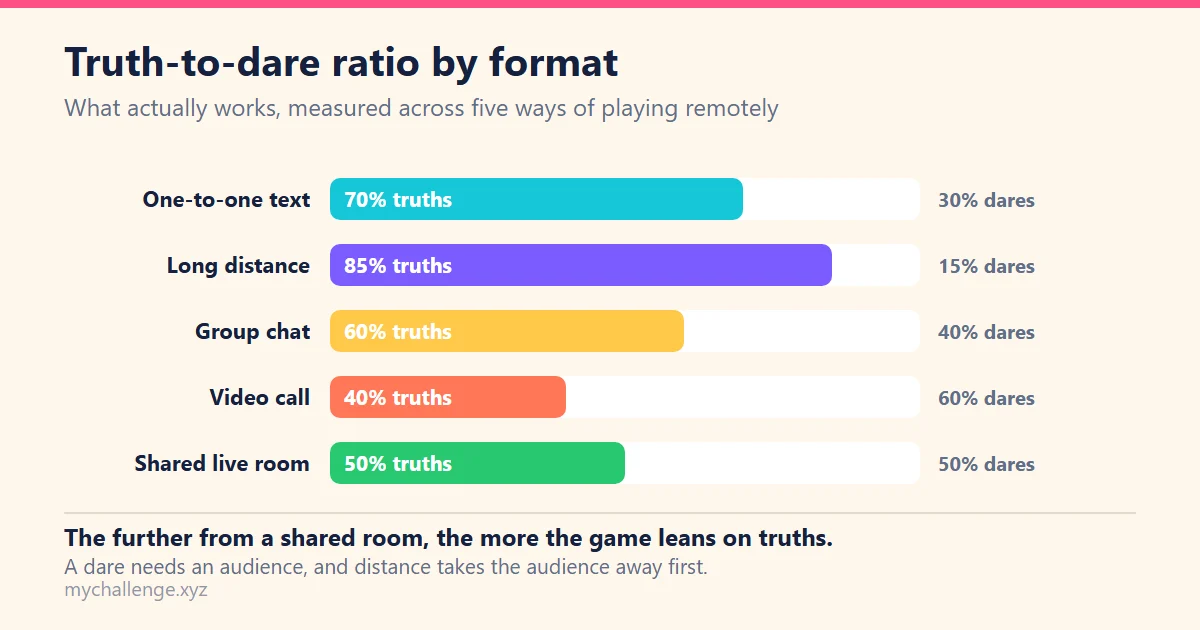
The pattern in that table is the summary of this whole guide. The further you get from a shared physical space, the more the game has to lean on truths — because a dare needs an audience, and an audience is the thing distance takes away first.
It is worth noticing that the shared room is the only format that comes back toward an even split. That is not a coincidence and it is not a feature list — it is simply what happens when you restore a synchronous audience without also restoring the reader problem. Everything else on that table is a compromise with one or the other.
Where to go next
- Open a Truth or Dare room — everyone joins from their own phone, no reader required.
- The full question bank — filterable by age rating and intensity if you want to build your own text set.
- 104 funny dares for friends — the in-person versions, sorted into escalation tiers.
- What a pass should cost — the forfeit ladder, which matters more over text than in person.
- Games like Truth or Dare — several of them survive remote play better than this one does.
Frequently asked questions
How do you play Truth or Dare over text?
One person asks “truth or dare”, the other picks, and the asker sends a prompt. The two rules that keep it alive are a deadline — usually ten minutes to respond before the turn expires — and proof for dares, in the form of a photo, screenshot or voice note. Without those two, the game becomes a conversation and stops within about four messages.
What are good dares to do over text?
Anything that produces evidence. Send a voice note singing, change your profile picture for an hour, screenshot your most-played song, text a friend a specific harmless sentence. Dares that happen out of sight of the other player do not work, because there is no way to complete the loop.
How do you play Truth or Dare long distance?
Same loop, longer clock. With a time difference, switch from a ten-minute deadline to one turn each per day and treat it as an ongoing game rather than a session. It works considerably better than trying to synchronise two people in different time zones for an hour.
Is Truth or Dare better over text or on a video call?
Text is better for truths, because people write more honestly than they speak and nobody has to hold eye contact. Video is better for dares, because a dare needs an audience. The problem with video is that somebody has to read the prompts out, and that person stops playing — which is why a shared room where everyone sees the same prompt on their own screen beats both.
How many players can play over text?
Two works well. Three to five in a group chat works if you enforce turn order explicitly. Above about six, a group chat collapses — several people answer at once, the thread scrolls past the prompt, and nobody can tell whose turn it is.

Keep reading

The History of Truth or Dare: How a Medieval King's Game Ended Up on Your Phone
Truth or Dare has no inventor. It has ancestors — a Greek game recorded by a second-century grammarian, a medieval French courtship game, and an English parlour game that Joseph Addison recommended for a winter evening in 1711.

Truth or Dare Punishments: What Should Actually Happen When Someone Says No
A forfeit is a price, not a penalty. The difference decides whether a refusal keeps someone in the game or pushes them out of it — and almost every group gets it wrong by not deciding at all.

14 Games Like Truth or Dare, and When Each One Is the Better Call
Every alternative to Truth or Dare is a trade between how much people reveal and how many people it works with. Pick by group size first — it predicts success better than anything else.