104 Funny Dares for Friends That Need No Props and No Apology
Sorted into three tiers, because the fastest way to ruin a game is to open with the biggest dare you have.

Most dare lists fail for the same reason. They are written to be read, not performed. Somebody types “dye your hair blue” into a list of a hundred and it looks great on the page, and then a real group hits it at 9pm on a Tuesday and everyone stares at each other until the turn is skipped.
These 104 are the other kind. All of them can be done in a normal living room, right now, by a person who is sitting down and did not plan for this. None of them need props, a shop, a car, or anyone leaving the room. And they are sorted into three tiers, because handing a group your best dare in round one is how you end up with nowhere to go for the next hour.
What separates a funny dare from an awkward one
Watch enough games and the pattern is obvious. Dares that land share three properties, and dares that die are missing at least one.
It is performed, not revealed
The funniest dares are physical or verbal performances. The person is doing a silly thing, everyone is watching, and the humour comes from the doing. The moment a dare's punchline depends on information about the player — an old photo, a message, a preference — it has become a truth question wearing a costume, and it carries all of a truth question's risk with none of its warning.
It is over quickly
Sixty seconds is the ceiling. A dare that takes four minutes is not four times funnier; it is a room slowly checking its phones while one person performs. Speed is doing more work here than content.
The embarrassment is shared
A dare that makes one person look ridiculous in front of six others is a punishment. A dare where the room ends up complicit — everyone joins in, or the target picks who else is involved — reads completely differently, even when the action is identical.
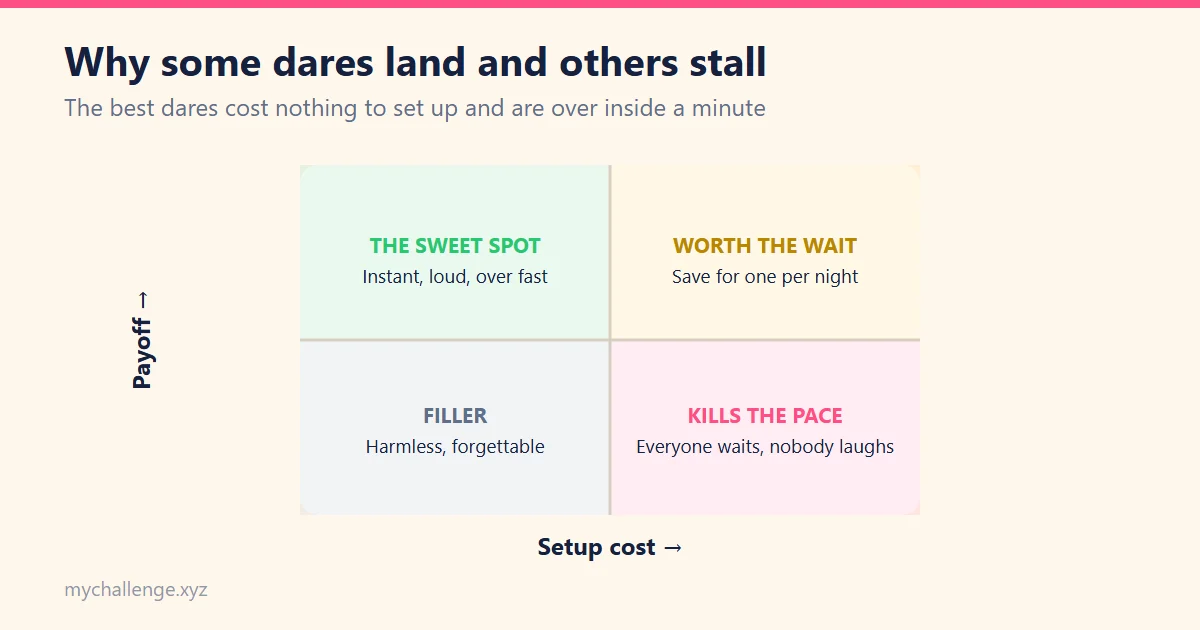
There is a fourth property that only matters at scale: a good dare is repeatable across the group. If a dare only works on one specific person, you have written a joke about them rather than a prompt, and you will not be able to use it again.
Tier one: 24 warm-up dares you can do sitting down
Use these for the first twenty minutes. Nobody has to stand, nothing is at stake, and their real function is calibration — the group learns what kind of night this is going to be.
- Narrate what everyone in the room is doing for sixty seconds, in the voice of a wildlife documentary.
- Speak only in questions until your next turn. Any statement costs you a second dare.
- Do an impression of the person on your left until somebody guesses who it is.
- Read the last thing you said out loud, but as a Shakespearean soliloquy.
- Invent a conspiracy theory about the piece of furniture nearest to you and defend it for thirty seconds.
- Let the person opposite give you a new accent. Keep it for three rounds.
- Describe your morning routine as if it were the trailer for an action film.
- Compliment everyone in the room, but each compliment must be worse than the last.
- Say the alphabet backwards. Every mistake adds ten seconds of silence you must sit through.
- Pick any object in the room and sell it to the group as though it costs nine hundred pounds.
- Answer every question for the next two rounds in the third person, using your full name.
- Do the last thirty seconds of a dramatic film death scene, using only the word “potato”.
- Give the group a sixty-second lecture on a subject you know nothing about, with total confidence.
- Laugh continuously for twenty seconds. Nobody else in the room may laugh.
- Rank everyone in the room by how well they would survive a zoo escape, and justify the bottom two.
- Speak in a whisper for the rest of the round, including when it is not your turn.
- Describe the plot of the last thing you watched, badly, until someone can name it.
- Take on the personality of the person to your right for two full rounds.
- Hum a song until somebody guesses it. You may not tap the rhythm.
- Give a live weather forecast for the room, including a warning about one specific person.
- Say something genuinely nice about the person you have known the longest, in the style of a football commentator.
- Replace every noun you say with “thing” for one round and try to hold a conversation.
- Do your best impression of the group's collective reaction to the last dare.
- Explain, seriously, why the last person to speak is the villain of this evening.
Timing note: if the group is still quiet after six of these, the problem is not the dares. Somebody needs to take a turn without being asked, and that person should be whoever suggested the game.
Tier two: 24 dares that get people out of their chairs
Roughly twenty minutes in, the room needs to move. Standing dares are the single most reliable way to reset the energy of a game that has flattened out, and they scale much better to larger groups because everyone can see them.
- Perform a thirty-second interpretive dance of the last text you received.
- Do a lap of the room as though you are being filmed in slow motion for a sports montage.
- Teach the group a dance move you have invented. Everyone must attempt it.
- Deliver a two-minute best-man speech about the person to your right. Nobody is getting married.
- Re-enact how you got out of bed this morning, in the style of a horror film.
- Stand on one leg and recite something you learned at school until you wobble.
- Have a passionate argument with the coat rack. You are losing.
- Do a catwalk of the room wearing one item borrowed from every person present.
- Act out your commute in mime until someone correctly guesses your transport.
- Attempt a cartwheel. If you cannot, do a dramatic re-enactment of a cartwheel.
- Sing the chorus of a song of the group's choosing, in the style of an opera singer.
- Balance something soft on your head and cross the room. Any drop restarts the crossing.
- Do the sound and the movement of the last animal anyone in the room mentioned.
- Give a tour of the room as though it is a historic house and everything is priceless.
- Do twenty star jumps while listing things you are grateful for. One per jump.
- Reenact a famous film scene with the person to your left, who has not been told which scene.
- Be the doorman for the next three rounds. Announce every person who leaves or enters.
- Do an impression of someone in the room without speaking. The group has thirty seconds.
- Conduct the room like an orchestra. Everyone must make a sound when pointed at.
- Walk backwards to the furthest corner of the room while narrating your own progress.
- Perform a dramatic reading of the nearest set of instructions, label or packaging.
- Swap seats with someone and adopt their posture exactly for the rest of the round.
- Do a sixty-second stand-up set where every joke is about the room you are standing in.
- Lead the group in a chant of your own invention. It must be about the host.

Tier three: 24 phone dares
The highest-risk category and, handled properly, the funniest. Phone dares work because a phone is a genuinely personal object and everyone in the room knows it. They stop working the moment they involve somebody who is not in the room and has not agreed to be part of the evening.
The line that matters: any dare that sends something to a person outside the game needs that person's buy-in, or it needs to be harmless enough that they would laugh at it. Messaging an ex, a boss or a stranger is not a dare — it is using a game as cover for something you would not otherwise do.
- Read out the last five words you typed into a search bar, in a newsreader voice.
- Show the group the fourth photo in your camera roll and explain it.
- Let the person on your right choose your ringtone for the next week.
- Read your most recent note or reminder out loud, exactly as written.
- Show the group your most-used emoji and defend it.
- Let the group pick which app you delete for twenty-four hours.
- Read out the last thing you sent to the group chat, then argue against it.
- Show the screenshot you have kept the longest and explain why it survived.
- Play the last song you listened to. The room votes on whether it is defensible.
- Let the group rename one of your contacts. It stays until next game night.
- Read out your last three calendar entries in the voice of a sports commentator.
- Show your step count and explain it to the group as though it were a personal best.
- Let the room choose one photo from your camera roll to become your lock screen for an hour.
- Read out the notification you have been ignoring the longest.
- Show the group the oldest unread message in your inbox.
- Let the person opposite type your next message in the group chat. You must send it.
- Read out the last voice note you received, but act it rather than play it.
- Show your screen time for yesterday and take questions for thirty seconds.
- Let the group choose an unflattering photo of you and make it your profile picture for an hour.
- Read out every word in your predictive-text bar after typing “I honestly”.
- Show the group the last thing you added to a basket and did not buy.
- Give the room your phone's battery percentage and let them decide your consequence for it.
- Read the last thing you wrote in a review or comment anywhere.
- Let the group scroll one month of your camera roll. You choose the month.
If a phone dare produces a visible flinch, take it back. There is no version of this that is worth an actual bad moment, and the round is not so precious that it cannot be replaced with something from tier one.
12 dares for exactly two people
Two-player Truth or Dare is a different game — there is no audience, so a performed dare has almost nothing to work with. These lean on cooperation and mild competition instead.
- Have a two-minute conversation where neither of you may use the word “I”.
- Guess the other person's phone battery percentage. Loser takes an extra dare.
- Mirror everything the other person does for ninety seconds. They are trying to break you.
- Try to make the other person laugh using only eye contact. Sixty seconds.
- Draw a portrait of the other person in thirty seconds without looking at the paper.
- Each write a one-sentence review of the other's outfit and read them at the same time.
- Take turns adding one word to a story. It must end with a moral.
- Recreate how you met, with both of you playing the wrong person.
- Have an argument about something trivial, but you must each argue the other's position.
- Rank the last five things you both ate. Any disagreement costs a dare.
- Do a synchronised dance to a song neither of you has heard before.
- Say what you thought of the other person the first week you met, then swap.
12 dares for a big, loud room
Past about ten players, turn-based dares stop working — the wait between turns gets long enough that people drift. These involve everyone at once, which is what a big room actually needs. Our friends deck leans the same way.
- Everyone freezes. The last person to notice takes the next dare.
- Point at the person most likely to survive a week without their phone. Nobody may explain.
- Everyone does their best impression of the host, simultaneously, for ten seconds.
- Start a chant. Anyone not joining within five seconds takes a dare.
- The room splits into two teams and performs the same film scene. The host judges.
- Everyone swaps one item of clothing with the person to their left.
- Everyone writes one word on a slip. The dare is to make a sentence from all of them.
- The room must arrange itself in order of who woke up earliest, without speaking.
- Everyone tells the same two-sentence story, and one person is lying about it.
- Every person makes one sound. The room must perform them together as a song.
- Everyone must speak in an accent chosen by the person to their right for one full round.
- The whole room does the dare from the last round, all at once.
8 dares that work over a video call
Remote play strips out most physical dares — nobody can see below the shoulders, and half the room is on a phone screen the size of a playing card. What survives is anything involving the frame itself. There is more on this in our guide to playing Truth or Dare over text and video.
- Change your background to the least appropriate thing available and keep it for three rounds.
- Leave the call and rejoin under a name the group chooses.
- Bring the group the strangest object within arm's reach and explain its history.
- Turn your camera to face something in the room and let the group interrogate it.
- Do the round in an accent, but you must keep denying that you are doing an accent.
- Mute yourself and act out the answer to the next question.
- Give the group a two-minute tour of the room you are sitting in.
- Let the group choose your display name for the remainder of the evening.
Dares that suit the occasion
The same dare reads completely differently depending on why everyone is in the room. A few adjustments are worth making.
Sleepovers
The classic setting, and the one where the tier system matters most, because the group is usually young enough that one badly judged dare gets talked about at school on Monday. Stay in tiers one and two for the whole night, skip phone dares entirely, and lean on performance: accents, impressions, invented dances, dramatic readings. The teens deck filters to roughly this level automatically.
Birthdays
The birthday person should be exempt from tier three and should get the choice of who goes next. Beyond that, the best birthday dares involve the group doing something about the person rather than to them — a speech, a synchronised performance, a group re-enactment of a shared memory. They produce something people keep.
New Year and big parties
Group dares only. At a party the room is too loud for anything requiring listening and too large for anything requiring turns. Everything from the big-room list above works; almost nothing from tier one does, because a seated dare is invisible past the third row of people.
Long car journeys
Everyone is seated, facing forward, and cannot see each other properly, so the visual dares are out and the verbal ones become excellent. Accents held for a number of miles, invented commentary on passing scenery, a story told one sentence per person, singing whatever comes on next in the style the group chooses. The constraint of the car is what makes them funny.
Family gatherings
The trap is that a family contains several different age groups and levels of comfort, and the same dare is charming from one person and mortifying from another. Use tier one only, make every dare something a grandparent could plausibly attempt, and let people opt into more if they want it. This is the one setting where under-shooting is much better than getting it right.
The dares to leave out
Almost every list on the internet contains a handful of these. They are worth naming, because they do not fail gradually — one of them lands and the evening changes.
- Anything involving unidentified food. The “mystery mixture” dare is a staple and it is a bad one: it has a real chance of an allergy, and no chance of being funnier than it is unpleasant.
- Anything that leaves the building. Knocking on a neighbour's door, going outside in the cold, running down the street. The group is now standing around waiting, and there is a stranger involved who did not sign up.
- Anything permanent. Haircuts, marker pen on skin, anything posted publicly. A dare should not still be true tomorrow.
- Anything aimed at one person repeatedly. Three dares in a row involving the same target stops being a game and becomes a pile-on. Nobody plans this and it happens constantly.
- Anything that requires alcohol to be funny. If the dare only works because someone is drunk, it is not a dare, and it will read very differently to the person doing it.
A useful test before adding a dare to your bank: imagine the person who is quietest in the group getting it on their first turn. If the answer is that they would freeze, it belongs in a later tier or nowhere.
How to write dares that fit your specific group
Generic lists get you through the first half hour. The ones people remember are always the ones that could only have been written for that room, and they are not hard to produce.
Start from a shared reference
Every group has three or four running jokes, a disastrous shared memory and at least one person with a famously strong opinion about something trivial. Each of those is a dare. “Do the thing Sam does when the food arrives” is not a prompt anyone else could write, and it will get a bigger reaction than anything on this page.
Use the room you are in
Look up. The furniture, the view, the noise from upstairs, the thing on the shelf nobody has explained. A dare that references the physical space is instantly specific, costs nothing, and cannot be recycled from a list — which is exactly why it feels different.
Write the constraint, not the action
“Be funny” is not a dare. “Speak only in questions” is. The reliable formula is a small, arbitrary rule applied for a fixed period, because the comedy comes from watching somebody navigate the rule rather than from the rule itself. Almost every dare in tier one is built this way.
Keep a running list
The best dare of any given night usually gets invented at about the ninety-minute mark by someone who is no longer trying. Write it down. Six months of doing this and you have a bank that no website can match.
Running the tiers in practice
| Point in the evening | Tier | What you are actually doing |
|---|---|---|
| First 10 minutes | Warm-up only | Calibrating. Finding out what this group will do. |
| 10–40 minutes | Warm-up + standing | Building energy. Get people out of their seats early. |
| 40–80 minutes | All three | The main event. Phone dares land best here, not sooner. |
| Final 15 minutes | Standing + group | Loud, everyone involved, then stop. |
The rule that ties it together: unlock a tier only when every player has completed one from the tier below. It sounds bureaucratic and it is the single most useful thing on this page, because it stops the boldest person in the room dragging the intensity somewhere the quietest person never agreed to go.
And end deliberately. The best dare of the night should be the last one — not because the game has run out, but because somebody decided to stop while the room was still loud. Every group that does this asks to play again.
Keep going
- Play Truth or Dare online — the dares get dealt at random, so no one in the room has to be the person who picked it.
- Browse the full question and dare bank — filter by age rating, intensity and category.
- What to do when someone refuses a dare — the forfeit ladder, and why “no passing” ruins a game.
- 14 games like Truth or Dare — for when the group has had enough dares.
- Where dares came from in the first place — the forfeit is two thousand years old and used to involve soot.
Frequently asked questions
What is a good dare that is funny but not embarrassing?
Anything performed rather than confessed. Impressions, accents, invented commentary and silly voices all get a laugh without exposing anything private. The rule of thumb: if the dare is funny because of what the person does, it is safe; if it is funny because of what it reveals, it is a truth wearing a dare costume.
What are some easy dares to do at home?
Seated warm-ups need nothing but the room you are in — narrate the next sixty seconds like a wildlife documentary, speak only in questions until your next turn, or do an impression of the person on your left until they guess who it is. All of tier one below is designed for exactly this.
What dares should you never use?
Anything involving food you cannot identify, anything requiring someone to leave the building, anything that lands on a person who is not playing, and anything whose consequences outlast the evening. A dare that ends in a broken thing, a hurt person or a message that cannot be unsent is not a dare, it is a bad decision with a rule attached.
How many dares do you need for a game night?
About forty for a group of six. That sounds excessive until you count: six players, four rounds each, and roughly half of them choosing dare. Improvising past the first ten is where every game night quietly dies.

Keep reading

The History of Truth or Dare: How a Medieval King's Game Ended Up on Your Phone
Truth or Dare has no inventor. It has ancestors — a Greek game recorded by a second-century grammarian, a medieval French courtship game, and an English parlour game that Joseph Addison recommended for a winter evening in 1711.

Truth or Dare Punishments: What Should Actually Happen When Someone Says No
A forfeit is a price, not a penalty. The difference decides whether a refusal keeps someone in the game or pushes them out of it — and almost every group gets it wrong by not deciding at all.

14 Games Like Truth or Dare, and When Each One Is the Better Call
Every alternative to Truth or Dare is a trade between how much people reveal and how many people it works with. Pick by group size first — it predicts success better than anything else.